The wind bit cold across the high valley, cutting down from peaks that vanished into cloud and shadow. Ice ruled this place—an ancient glacier lay ahead like a frozen god, pale and immense, its cracked surface glowing faintly blue in the waning light. The air was still, but wrong: too dry, too silent, too lifeless.
Elora was the first to feel it—a deep unease that set the hair on her arms rising beneath her cloak. The few shrubs that clung to the scree were brittle, gray, and yet impossibly still alive, refusing the natural death that should have claimed them. It was wrong in a way that only druids could feel in their bones. “These should be dead,” she murmured, kneeling beside a twisted bush. “But they cling on, unnaturally.”
Thorn crouched beside her, his eyes narrowing. The air around him shimmered faintly as he murmured the old elven words of power. “A lich’s touch, perhaps,” he said softly. “Death without release. A mockery of nature’s cycle.”
Behind them, Maledurk snorted, a puff of steam curling from his nostrils. “Undead trees. Zom-trees.” He grinned, proud of himself. “Sounds like a band name.”
Tempest burst into laughter, sparks of blue energy crackling from her fingertips as she tried—and failed—to stifle the noise. The laughter, too, felt out of place here. Even sound seemed reluctant to linger long in this valley of ice and dust.
Ahead, the glacier loomed closer, and the fissure at its base gaped like the mouth of some buried god. The heroes advanced single file, their boots crunching on frost-hardened soil. The ice swallowed them quickly—light dimmed, color drained, and soon the world was painted only in shades of deep cerulean and shadow.
The tunnel stretched on, unnervingly smooth, as if the two glaciers had pressed together for centuries and then, in some act of divine spite, split apart. Light filtered through the ice above in thin, ghostly beams. No sound but their breath. Then—dripping. A slow, patient drip that echoed impossibly loud against the stone floor beneath the ice.
They followed it, the sound leading them deeper until the fissure turned, revealing an opening that breathed warmth and the faint scent of mold. It was as though the mountain exhaled.
Maledurk went first, his broad shoulders squeezing through. Warm, humid air washed over him, heavy and moist, reeking faintly of rot and the memory of jungles long past. Beneath the glacier’s belly, a stone staircase spiraled downward, its steps slick with patches of ice where water froze mid-drip. Below, the faint glow of torchless light pulsed—a tomb breathing softly in the dark.
The barbarian turned back. “Feels like walking into the lich’s mouth,” he said, baring his teeth in something that wasn’t quite a smile. “Let’s see if he bites.”
Down they went, slow and careful. The stairs ended at a gate of iron bars—ancient, rust-pocked, but sturdy still. Beyond lay a vast stone chamber, the air thick with the scent of age and damp. Water dripped from unseen cracks above, gathering in small, glimmering puddles on the flagstone floor.
Elora’s keen eyes caught something strange—a puddle that did not ripple when struck by falling water. “That one,” she said. “It’s not right.”
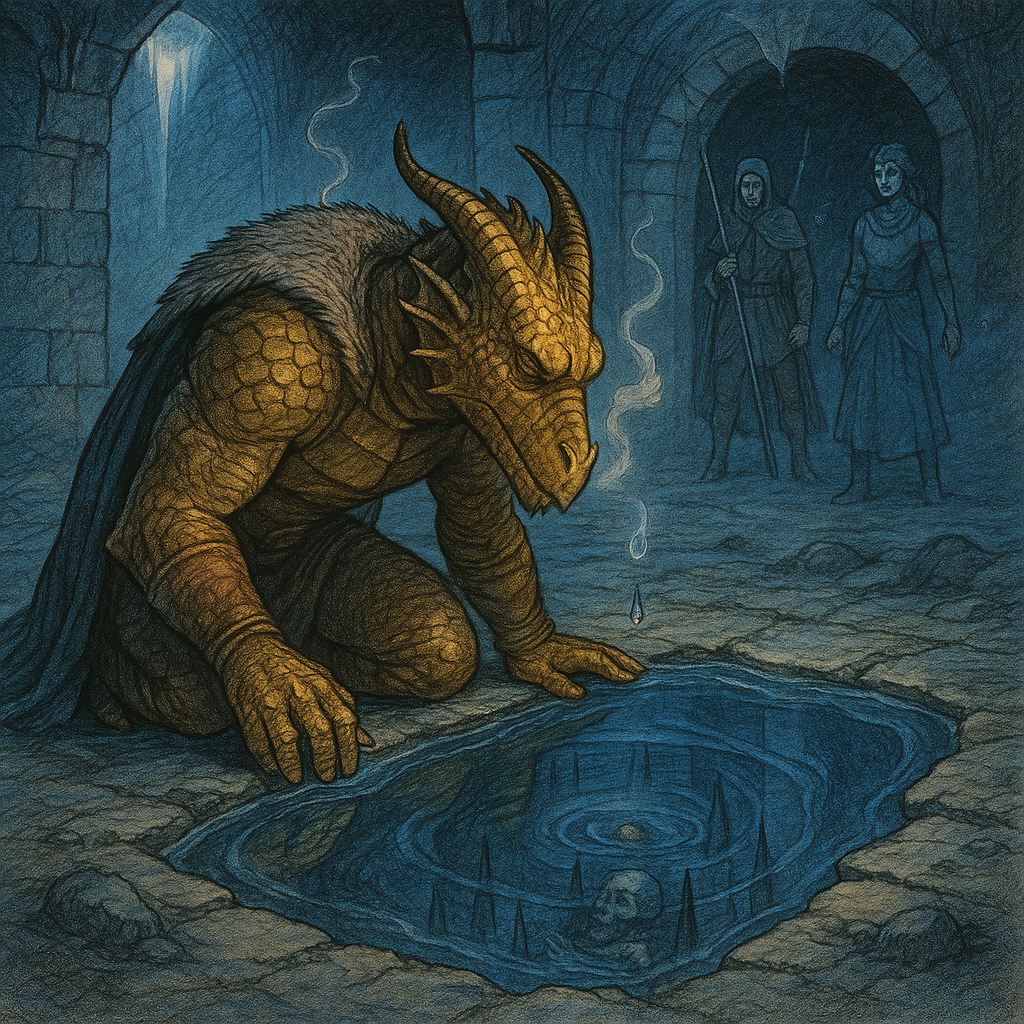
The others peered closer. Thorn murmured a spell and felt the faintest hum of magic—a false shimmer cloaking what appeared to be ordinary water. Elora extended her staff and pressed its tip into the puddle. It sank through effortlessly, vanishing as if swallowed by smoke. She drew it back dry.
Her brow furrowed. “It’s not water.”
Maledurk grinned. “Bet it’s treasure.”
Before anyone could stop him, he dropped to his knees and shoved his head through.
At once, all sound died.
He saw darkness first—then, slowly, the faint outlines below: a shaft, fifteen feet deep, lined with spikes like the jaws of a beast. Skeletons lay impaled upon them, silent as the grave. His heart hammered in his chest, though he could not even hear it. He pulled back with a gasp, shaking frost from his beard.
“A pit,” he said. “Spikes. Bodies. No sound down there. I could fall in and scream forever, and you’d never know.”
Thorn’s eyes flashed with understanding. “Silence magic. And illusion. A trap for the curious.”
Tempest leaned over, peering with one eye. “A puddle of death. Lovely.”
Cautious curiosity warred with pragmatism. Elora shifted, her form rippling and shrinking until a small monkey stood where she had been. She darted through the iron bars, rematerializing inside the chamber to raise the lever that lifted the portcullis. The gate groaned open, and the party advanced into the heart of the tomb.
The chamber stretched wide and low, stone walls sweating with age. The false puddle loomed ominous beside the entrance, and beyond it another archway beckoned—an invitation none of them trusted. The floor was cracked, uneven, veins of dark stone snaking toward shadowed corners. The air felt thicker now, as though time itself moved more slowly here.
Maledurk, ever bold, descended into the pit itself, bracing his arms and legs against the walls, lowering himself past the illusion into silence. The spikes were real. The skeletons, human. Scratched into the wall near one skeletal hand were crude words: I wish I hadn’t fallen down here.
He felt the weight of centuries pressing in on him. No tools. No ropes. No gear on the corpses. Just bones and despair. The silence down there wasn’t merely magical—it was absolute. Even his thoughts seemed dulled by it.
When he climbed back up, his breath was shaking. “It’s just death,” he said quietly. “A dead end.”
They moved on.
Beyond the illusory pit, a second chamber opened. The air grew warmer, thicker. Water pooled on the floor in dark puddles, and faintly, they heard something new—a slow, ragged sound, like breath.
Three figures hung upon the far wall.
At first they seemed statues, then prisoners, then—alive. Barely. Their chests rose and fell shallowly, skin pale as marble, eyes closed. The party froze, instincts warring between compassion and caution.
Elora felt the pull of life there—faint, unnatural, like the trees in the valley. Thorn sensed enchantment, the residues of binding and preservation spells woven deep. Maledurk’s hand drifted to the hilt of his axe. Tempest whispered, “Well, that’s… not foreboding at all.”
The glacier groaned above them, an ancient sound of weight and age, as though the mountain itself warned them to turn back.
None of them did.
The party had previously determined that the guide they were speaking with was a tree; she then spoke to them. This was Jareth, who provided limited answers but a direction: a witch in the High Forest mountains might divine who/what is interfering with the party’s lives, but she requires several magical ingredients. The group arrived in a mountainous valley, surrounded by taller peaks, with a glacier filling the valley ahead and a visible fissure at the glacier’s base about 100 yards away. Environmental observations (Nature/Arcana checks): The party approached the fissure: Survival assessment: Proceeding into the fissure: Party discussion clarified the goal and context: History/lore (History checks and prior knowledge): Advancing toward the source of dripping: At the stair bottom: Opening the way: Inside the entry chamber: Layout: open area with archways leading to additional spaces both right and left. Several puddles dotted the floor. Elora noticed a larger puddle on the left that did not ripple when a drip hit it and produced no sound, unlike three nearby smaller puddles that clearly rippled and splashed. Examination of the suspicious puddle: Identifying the trap’s magic: Investigating the shaft bottom: After discussion of options (e.g., Elora wild shaping into a climbing creature, using rope, or flight), Maledurk climbed down chimney-style with an Athletics check (success). At the bottom, Maledurk confirmed: Observations from above while he was below: Additional detail noted in the chamber: the skeletons had no clothing or gear present. (In-session possibilities were mentioned: items removed by others or extremely long decay.) Bypassing the trap: The next chamber (to the right through the archway): The session concluded upon the discovery of the three wall-tacked figures.Session Notes