The mountain did not welcome them, yet it did not deny them either. Its stone bones opened to admit them into a hidden world where roots drank from unseen light and a forest breathed beneath the earth. In that strange hollow, where no sun shone and yet everything lived, the cabin waited—quiet, patient, as though it had always known they would arrive.
Within, warmth gathered around the hearth. Herbs hung drying in careful bundles, their scents mingling with the richer aroma of meat and earth. The gnome woman moved with an ease that suggested ownership not just of the space, but of something deeper—of the unseen currents that shaped it. She welcomed them without surprise, as though their journey had been expected long before they themselves understood it.
The pot simmered.
Ingredients they had risked life and limb to gather disappeared beneath her practiced hands, reduced to fragments, to essence. The bubbling thickened, transformed. Steam curled upward in lazy spirals, carrying with it the promise of something more than simple sustenance.
When she beckoned Maledurk forward, the great dragonborn leaned in without hesitation, drawn by curiosity as much as by the scent. The surface of the stew shifted and turned, swallowing and revealing its contents in a slow, hypnotic dance.
“Tell me what you see.”
He searched the depths, expecting revelation—some grand unveiling of fate or hidden truth. His thoughts sharpened, focusing on what mattered most to him: his companions, their struggles, the ever-present threat that loomed just beyond understanding. He spoke what he imagined, what he hoped.
And yet, there was nothing there but stew.
The gnome’s laughter broke the tension like a snapped thread. The illusion collapsed, leaving behind only the simple truth: a meal, nothing more. What they had hunted across wilderness and ruin had become, in the end, her dinner.
Yet the jest did not erase the weight of what followed.
As they ate, the gnome’s demeanor shifted—subtle at first, but unmistakable. Her eyes lingered too long. Her thoughts stretched toward something beyond the room. When the crown was revealed, the atmosphere tightened, as though the forest itself held its breath.
It was an ugly thing. Twisted. Thorned. Wrong.
She studied it with a seriousness that stripped away any remaining pretense. When she brought it to the fire, holding it within the flames as though heat could coax truth from it, the air thickened with unseen pressure. Smoke rose—not gray and drifting, but black and purposeful, shaping itself into something more.
A battlefield emerged in that darkness.
Thorn recognized it at once. Not as memory alone, but as a reflection—an echo given form. The clash of armies, the dead rising to meet the living, the terrible inevitability of it all. But this time, he stood outside it. A witness, rather than a participant.
The vision collapsed as quickly as it had formed.
Her conclusion came with a quiet gravity that pressed against them all. The crown was not merely cursed—it was deliberate. Crafted. A vessel of will. It did not simply corrupt; it sought. It waited.
It hunted.
The realization settled heavily: this was not an artifact to be discarded, nor a problem to be solved by distance. It was a thread tied to something far greater, something that extended beyond their understanding of the world itself.
And then—without warning—everything shifted.
The gnome’s focus fractured. Her words faltered. Her hand moved with sudden, unnatural certainty.
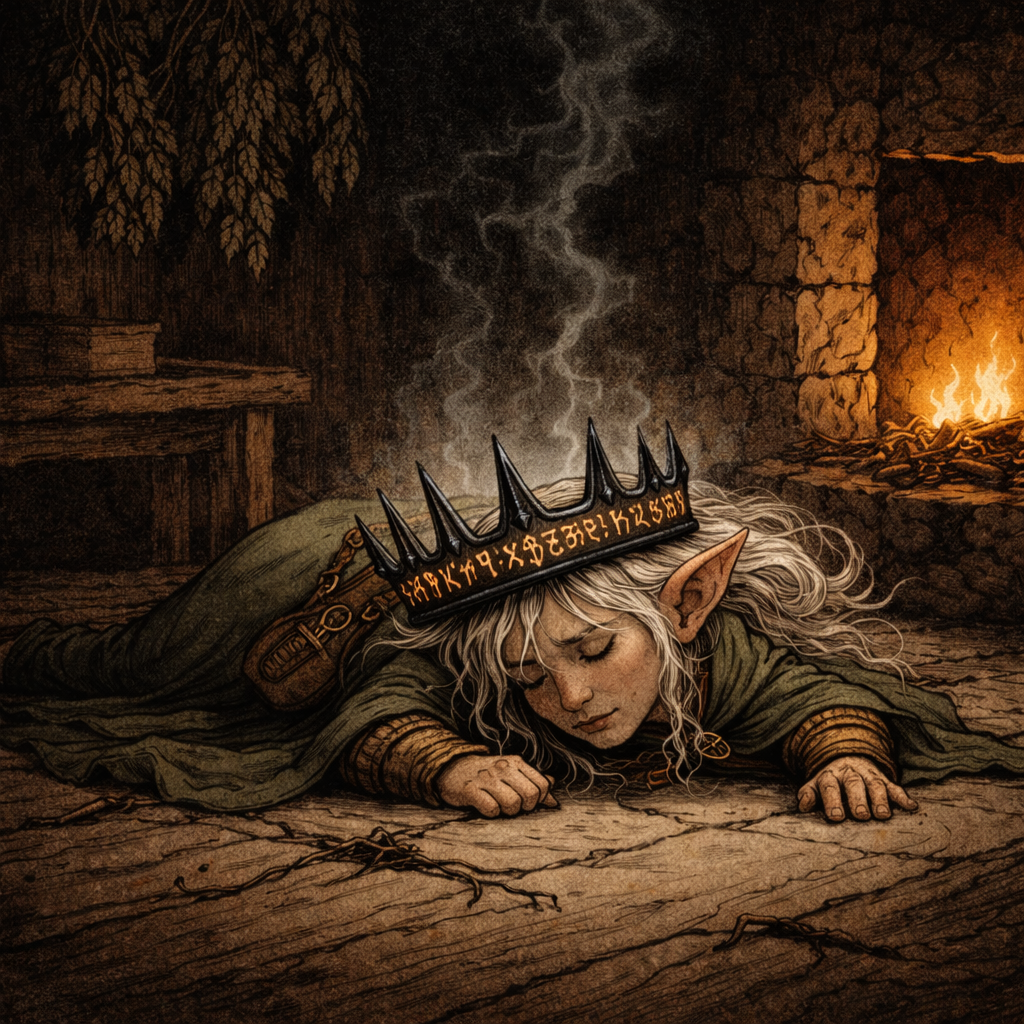
The crown settled upon her head.
She fell.
The stillness that followed was not peace, but anticipation. They moved quickly, recalling the desperation of the last time such a thing had occurred. Magic was summoned, channeled, cast—
—and vanished into something unseen.
The failure was immediate and wrong. The spell had not dissipated. It had been taken.
Realization came too late to matter.
She rose.
Her posture was not her own. Her presence had deepened, as though something vast had poured itself into a vessel far too small to contain it. When she spoke, the voice that emerged was not the one that had welcomed them, nor the one that had laughed beside the hearth.
It was older. Heavier. Certain.
“She would be here.”
The words lingered, heavy with implication, before she moved—swift, decisive—and leapt through the window into the forest beyond.
Silence followed her departure, but it was not empty. It thrummed with unanswered questions, with the echo of something vast shifting just out of sight.
And in that silence, a final, unsettling thought took root.
Perhaps the crown had never been meant for them at all.
Perhaps they had merely been the path.
Session Notes
-
The session resumed with the Dungeon Master recapping the party’s recent progress and current situation.
- The party had gathered the last ingredients requested by a witch living in the mountains.
- They had gone into the mountains seeking help understanding why their lives had been repeatedly disrupted by strange planar or dimensional events and why powerful beings kept interfering with them.
- On the way, they had encountered and followed a suspicious crow named Jacob.
- Jacob had led them into a cavern in the mountain.
- Inside the cavern, the party discovered a strange underground environment that looked like a forest despite being inside a cave.
- There was an unexplained light source illuminating the cavern, and plants and trees were growing there despite the underground setting.
- In the middle of this subterranean forest was a log cabin.
- Inside the cabin was a small gnome woman, though the cabin itself was built at normal human size.
- She had invited the party inside and appeared to have been expecting them.
- The cabin interior was simple, containing a hearth, a cooking area, a table, and chairs.
- Shelves and walls were lined with herbs, plants, cured meats, and other foodstuffs.
- The party had handed over all of the ingredients they collected.
- The gnome woman had put the ingredients into a pot with water, chopped them up, and begun cooking them, adding some other ingredients from around her kitchen.
- While the pot simmered and thickened, she asked the party what they wanted from her.
- The party explained that they wanted to understand what had been happening to them, whether there was a greater purpose behind it, and what they were supposed to be doing.
-
The scene resumed with the gnome woman inviting Maledurk to look into the pot.
- The pot smelled earthy, with herbs and spices.
- Its contents had thickened noticeably beyond the consistency of plain water.
- The woman stirred the pot while Maledurk leaned in to stare into it.
-
The gnome woman asked Maledurk to make a Perception check while he looked into the pot.
- Maledurk rolled a natural 20.
- He noticed the smell was very inviting and focused intently on the pot’s contents.
- The rest of the party saw the woman watching Maledurk very closely as he stared into the pot.
- The woman asked him what he expected to see.
- Maledurk said that he expected to see his friends and some evil being trying to harm them.
- He also expected to see the party rally together and defeat that foe.
-
As Maledurk continued staring into the pot, the woman repeatedly asked him what he saw.
- Maledurk observed only the actual contents of the stew.
- He saw a mushroom float briefly to the surface and sink back under.
- He saw pieces of blood gourd and other ingredients moving around in the broth.
- He saw the swirls and eddies made by the stirring.
- No true vision appeared to him.
- When prompted again, Maledurk answered as though he was seeing a vision anyway, saying that a bad person was trying to hurt his friends and that they all came together and defeated him.
-
The gnome woman reacted with surprise and amusement to Maledurk’s answer.
- She said she had never thought that would actually work.
- She said Maledurk must have a very vivid imagination.
- She laughed and revealed that the pot contained only stew.
- She explained that she had requested the ingredients because she could not easily obtain them in the mountains and that the recipe was her favorite.
- She said she liked to play that joke on visitors.
- She explained that most people simply looked into the pot and admitted that they only saw ingredients.
- She was amused that Maledurk had fully committed to describing a vision.
-
The woman served the stew to the party and invited everyone to sit at the table with her.
- She gave Maledurk a bowl first, then served additional bowls to the others and one for herself.
- She repeated that the cauldron vision was just a joke she liked to play.
- She specifically told Maledurk that she liked him and pinched his cheek.
- The moment emphasized the physical contrast between her small gnome form and Maledurk’s much larger dragonborn body.
-
The party sat with the woman and ate, though not everyone participated in the same way.
- Maledurk ate and enjoyed the stew.
- Tempest also ate and seemed to enjoy it, while also thinking about the cooking techniques involved.
- The stew was described as very good.
- Elora did not eat.
- Instead, Elora remained watchful, observing the others closely and staying suspicious of the situation.
-
After the joke was over and everyone settled at the table, the tone became more serious.
- The gnome woman said that despite the joke, she could tell something truly was troubling the party.
- Based on their stories, she believed their suspicions were probably correct.
- She said that some powerful entity had clearly noticed them and had been interfering with their lives.
- She remarked that many adventurers run into one godlike being in the course of their lives, but the party’s experiences seemed to involve several such powerful forces.
- She specifically noted that the number was around four, which she said was very unusual.
-
During this conversation, the matter of the crown came up.
- The woman asked about the crown still in Elora’s bag.
- Elora had not previously mentioned the crown in her account of the party’s experiences.
- The woman asked to see it.
- Elora took it out and showed it to her.
-
At this point, it also became clear that the party had not yet told the woman about Thorn’s experience wearing the crown.
- When asked whether he had described the visions he saw while wearing it, Thorn said he had not.
- The woman examined the crown physically.
- The crown was described as ancient, troubled, and unfriendly in appearance.
- It was not ornate or decorated with jewels.
- Instead, it looked twisted, thorny, and almost rusty, though not literally rusted.
- It had sharp points and an ominous form.
-
The woman asked whether anyone had actually put on the crown.
- Thorn admitted that he had.
- She asked what had happened.
- Thorn then related his experience with the crown and the visions it had caused.
- The rest of the party explained that Thorn had collapsed or passed out when he wore it and had been difficult to awaken.
-
After hearing this, the woman examined the crown more closely and began testing it.
- She suggested that something was contained within the artifact.
- She said it must hold some kind of essence or memory.
- She walked back toward the hearth and held the crown near the fire.
- Smoke began to rise from the metal as it heated, though the metal had not yet turned red.
- She continued holding it and watching it intently.
-
The Dungeon Master called for Arcana checks from the party while the woman examined the crown.
- Thorn and Maledurk both recognized that the woman was doing something magical with the crown.
- Thorn, with greater magical knowledge, understood that she was trying to determine the crown’s magical nature.
- He recognized the purpose of what she was doing but also noticed that the way she used magic was very different from his own wizardly practice.
- She was not speaking formal incantations or using visible arcane gestures.
- Instead, her magic seemed innate, instinctive, and part of her very being.
- Thorn recognized that her magical method was unfamiliar and not something he had encountered directly before.
-
The woman eventually spoke a word the party did not understand and threw the crown into the fire.
- A large plume of smoke burst from it immediately.
- The smoke was much darker and denser than ordinary smoke.
- It rose quickly and then began taking visible shape.
- The smoke formed the image of a mountain pass or a valley between two mountains.
- Figures appeared in the smoke, running toward one another across a battlefield.
- Thorn realized that this was the same event he had previously seen in one of his visions while wearing the crown.
- This time, however, the scene appeared from a third-person perspective rather than from the first-person perspective he had experienced before.
- The battle depicted the army of undead fighting the living forces.
- After the image played out briefly, the smoke dissipated and fell away.
-
The woman then reached directly into the fire and retrieved the crown.
- She did so without apparent regard for the flames and without seeming to suffer harm.
- She turned back to the party and asked whether they had all seen what happened.
- The party confirmed that they had.
- She asked Thorn whether the vision resembled what he had seen before.
- Thorn confirmed that it was similar, though from a different perspective.
-
The woman explained what she believed the crown to be.
- She said the artifact contained the memories of a very powerful magic user.
- She said she had been trying to unlock some of those memories without actually wearing the crown.
- She believed the object was intended to be worn.
- She concluded that its purpose was likely to allow its creator to return by taking over the body of the wearer.
- She told Thorn that he had been lucky his friends were present when he wore it, because otherwise he might have succumbed fully to its power.
-
The woman addressed the name Nogbruth, which the party had associated with a lich.
- She said she had not heard that name before.
- She did not think Nogbruth was the crown’s true originator.
- Instead, she suspected Nogbruth might merely have been the last victim of the artifact.
- This implied that the crown and the entity behind it predated the lich the party had previously encountered.
-
The woman then speculated about the broader significance of the crown.
- She said it felt as though the party had been meant to find it.
- She worried that the artifact wanted to be found.
- She said it might have been guiding or arranging events to place itself before suitable candidates.
- She suggested that the entity behind it might be doing this all over the world, seeking out people who drew its attention through great deeds.
- She believed that those who survived its various tests were the ones it tried to draw closer.
-
Thorn asked whether, if he wore the crown, he might be able to fight the evil behind it once and for all.
- This prompted skepticism and concern from the others.
- The woman’s response was that they might have to find out.
- The possibility remained open but dangerous.
-
Elora tried to draw a larger purpose out of what the woman was saying.
- She asked whether this meant the crown and these strange events were the true reason behind everything the party had been going through.
- She asked whether this had become their real quest and whether they would ultimately have to deal with this power if they wanted to save the world.
- The woman responded by describing beings outside ordinary existence.
- She said there were entities beyond the plane of the world whose experience of reality and time differed from mortal understanding.
- She emphasized that she was not speaking of gods.
- She described the gods as powerful but vain, saying they liked worship.
- By contrast, she described this other force as something concerned with power itself.
-
The woman continued elaborating on her theory.
- She said the entity might have been testing the party.
- She said it may have arranged events in their path and set up challenges to see whether they were worthy of it.
- She speculated that many people across the world could be undergoing similar trials, with only the survivors being drawn further in.
-
The party asked whether the crown could be destroyed and whether destroying it would end the threat.
- The woman said nothing mundane would damage or destroy the crown.
- She specifically said Maledurk could strike it as hard as he liked and likely would not even dent it.
- She did not believe destroying the crown alone would solve the problem.
- She believed the party would have to confront the being behind it directly.
- She was uncertain whether the crown would continue to exist after its creator was destroyed.
-
The party also asked whether the crown could be used to locate the being.
- As they pressed for answers, the woman’s focus appeared to slip.
- She continued staring at the crown while speaking.
- She said repeatedly that the entity was very powerful and must be destroyed.
- Her speech became less coherent and began trailing off.
- She seemed to be losing concentration or being affected in some way.
-
The Dungeon Master allowed the party to make Insight checks as they watched her.
- The party had the impression that the woman had been sincere and aligned with their goals up to this point.
- She had not seemed deceptive earlier.
- Her helpfulness, good humor, and the fact that the party had been directed to her by trusted sources supported the impression that she had genuinely been trying to assist them.
- The party’s interpretation was that something had come over her suddenly rather than that she had been acting in bad faith all along.
-
Without warning, the woman reached out, seized the crown, and placed it on her own head.
- As soon as she did, she fell to the floor in the same way Thorn had collapsed when he wore it.
- She appeared unconscious.
-
The party reacted immediately and tried to save her.
- Their first instinct was to get the crown off her head.
- Thorn used Mage Hand to try to remove it.
- The crown would not budge.
- This matched the earlier experience when the crown had adhered to Thorn and could not be removed by force.
-
The party reviewed what had worked previously when Thorn wore the crown.
- Thorn remembered that he had tried to remove the crown himself from within the vision and had failed.
- That attempt had caused his vision to break and had dropped him into darkness.
- Elora remembered that Greater Restoration had been required to free Thorn from the crown.
- Lesser Restoration had not worked at that earlier time.
-
Elora decided to try Greater Restoration on the woman.
- Because the spell is a touch spell, she had to physically touch the target.
- As Elora reached down and attempted to release the spell onto the woman, she felt a sudden jolt like an electric shock before actually making contact.
- The sensation caused her to reflexively pull her hand back.
- She realized that the spell had still been released even though she had not touched the intended target.
- This meant the magic had gone somewhere, but not into the woman as intended.
- Elora did not know what had received the spell.
-
This result led to a new line of concern.
- Elora understood that Greater Restoration must be cast on a living creature.
- It could not meaningfully be cast on an inanimate object, and it would not simply discharge harmlessly the way it would if used on something invalid.
- Therefore, the spell must have been absorbed or redirected into some living being.
- This raised the fear that whatever force was associated with the crown might have received the restorative magic instead.
-
The party discussed the implications of the failed spell.
- Elora suggested that if some evil presence was involved, her spell might have strengthened or restored it.
- They considered the possibility that the woman was possessed and that the spell had affected the possessing force rather than the host.
- This was alarming because it suggested that the entity in the crown might now be more active or empowered.
-
The Dungeon Master then allowed additional Arcana checks based on Elora’s description of what she had experienced.
-
Thorn rolled extremely well and drew a deeper conclusion.
-
He reconsidered the woman’s earlier magical behavior, including:
- her ability to hold the crown comfortably when the rest of the party found even touching it unpleasant,
- her ability to reach into the fire and retrieve it without harm,
- the unusual, innate way she worked magic.
-
Thorn concluded that the woman was probably warded against magical effects.
-
He thought her protection might not merely repel magic but absorb it.
-
He recognized this as a kind of rare magical defense sometimes described in lore as functioning like a battery, taking in magical energy cast at it and potentially storing or repurposing it.
-
This made Thorn suspect that the woman was much more than an ordinary gnome living in a cabin.
-
He concluded that she was likely far more powerful and more unusual than she had appeared.
-
The party then tried to interpret what this meant for her nature and motives.
- Thorn concluded that her magical defenses did not inherently indicate that she was evil.
- Maledurk’s earlier impressions still suggested she had been friendly and sincere.
- The party did not think she had been maliciously deceiving them.
- Instead, the leading interpretation was that she had been genuinely helping them until the crown compelled her to put it on.
-
Elora also reflected on something the woman had said earlier about the gods.
- The woman had spoken of the gods dismissively, calling them vain and focused on worship.
- Elora, as a druid with a stronger sense of divine and natural forces, found that remark striking and inconsistent with her own understanding of divine beings.
- She knew the gods were real, active powers in the world with actual domains and responsibilities, not merely distant vanity-driven entities.
- This difference in outlook suggested to Elora that the woman did not see the gods from an ordinary mortal perspective.
-
Combining this with Thorn’s realization about the woman’s magical nature, the party considered that she might not be native to the Material Plane.
- Elora began to suspect that the woman herself might be an extraplanar being.
- This could explain both her unusual perspective on the gods and her deep knowledge of entities beyond normal reality.
- It could also explain why she seemed so comfortable with strange cosmic matters that ordinary mortals barely understood.
-
The party questioned whether the woman had a personal stake in the threat posed by the crown’s creator.
- They noted that although she had described the danger, she had not explicitly said that she herself feared it or had a direct personal reason to oppose it.
- They wondered whether, if she was from another plane, she might care differently about the world than mortal beings did.
- As they reflected on her words, they came to the sense that the threat she described extended beyond a single world or plane.
- It seemed to be a threat to existence more broadly, not just to their own realm.
-
The party also reconsidered the woman’s behavior in light of this possibility.
- They noted that she seemed amused by mortals and liked playing tricks on visitors, such as the joke with the stew.
- This implied she had likely been interacting with many travelers over time and not simply hiding in isolation.
- It occurred to them that she may simply have enjoyed being there.
- Another possibility raised was that the cave and cabin might have served as a kind of refuge or safe place for her.
- Regardless, they concluded that she probably was concerned about the larger threat, even if her relationship to the world was not the same as theirs.
-
While the party debated what to do, they looked over and saw that the woman had stood back up.
- The crown was still on her head.
- She looked around the room.
- When she spoke, it was in a different voice, much deeper than before.
- She said, “She would be here.”
- Immediately afterward, she leapt out the window.
-
The session ended on that sudden turn.
- The leap out the window was clarified as not involving a fatal drop, since the cabin was only one story within the cave environment.
- The party interpreted the act as an escape rather than a suicide attempt.
- They were left with the implication that the woman had been possessed or overtaken by the force connected to the crown.
- They also realized that a powerful and now-compromised extraplanar being might now be loose somewhere in their plane.
-
In the final discussion before ending, the party considered one more disturbing possibility.
- The woman had earlier suggested that the party might have been manipulated and tested so that the crown could reach them.
- But as she fled, the party began to wonder whether the whole chain of events had not been intended to lead the crown to them at all.
- They considered instead that the true target may have been the woman herself.
- Since she appeared to be much more powerful than any of them, she may have been a far more desirable host for the crown’s creator than the party.
- This possibility reframed many of the preceding events and made the situation seem even more dangerous.