A splinter of wood curled out from one of the claw marks beside the mansion’s window. Elora caught it with a fingertip and turned it over. Whatever had made the gouge had struck hard enough to strip the paint and bite into the frame beneath.
Outside, the last of the afternoon was thinning over Barovia. They had walked back from the church with the burgomaster in the ground and, buried with him, his daughter’s last reason to stay in the village. Vallaki lay several days off. Ismark believed his sister would be safer there, and they had agreed to take her. The sensible thing was to leave at dawn and put a full day’s walking behind them before the dark came round again.
Sensible things ought to have been easier to tell apart from the rest.
Elora let the splinter drop. This was the same battered house, the same frightened household, the same plea for help. The people they had met before looked no older and did not know them. Yet she remembered leaving Barovia while the world seemed to be coming apart at the seams. She remembered the haste, the horses, the fog. Whatever had become of this place afterward, it should not have been sitting here waiting for them with its troubles laid out in the same order.
Not quite the same, she corrected herself. The house on the island was gone. That was one difference, though it was not much to set against a whole village behaving as though they had never passed through it.
Thorn favored an early start. There was little point, he said, in spending the last scraps of daylight getting just far enough from shelter to regret it. Maledurk grunted his agreement. Rooms were offered, packs were set down, and the mansion settled around them with the small complaints of an old building cooling after sunset.
Elora went into her trance expecting the next sound to be claws on wood. Instead, somewhere in the dead middle of the night, she heard footsteps. They shuffled along the road in such numbers that no single tread could be picked out; it was one long, continuous scrape. She waited for a blow against the door, a cry, a shutter giving way. None came.
At the window, a green-white light touched the underside of the damaged frame.
People were passing the house. The first few came out of the dark in a dim radiance of their own: a warrior in armor, a figure with a bow slung across the back, someone in robes that stirred with each slow step. More followed. Elves, humans, dwarves, dragonborn. The glow lay along sword belts and shoulders and faces that looked only at the road ahead. Dust lifted under their feet and hung there.
Elora leaned toward the glass. They were ghosts. Everything she knew said so, even though she could hear them walking and the road answered them with dust. No light fell on them from above. It came from inside their shapes and pooled faintly around each small company until the next drifted in behind it. By the time the others were at the window with her, there seemed to be hundreds.
“They’re coming from the church,” Thorn said.
From that direction, at least. Beyond the church lay the graveyard. The procession passed the mansion without so much as a turn of the head. No one raised a weapon or spoke. These were not the villagers whose faces she had been studying all evening for a flicker of recognition. They wore the mismatched kit of travelers who expected trouble: different armors, different weapons, robes beside mail, nothing uniform enough to make an army of them. Little bands of adventurers followed one another down the road.
Then, near the rear, she saw two elves walking beside two dragonborn.
Her hand stopped against the window frame. There was the familiar set of Maledurk’s head, and beside him, Thorn’s face. Her own clothes, her own gear, moved on someone who wore them as easily as she did. And there was Tempest, who had stayed behind at the tower and was not even here to look out at herself. For a moment Elora found herself absurdly checking details, as if a wrong buckle might make this easier to bear.
“There,” she said, but Thorn had already seen.
Their doubles walked with the same unhurried tread as everyone else. They did not glance toward the house. The ghost wearing Elora’s face had its eyes fixed somewhere past the shoulder of the one ahead.
“Us,” Thorn said, and no one corrected him.
Elora was the first to leave the window. “Let’s go out.” It beat standing there watching herself disappear.
Outside, the cold sharpened the smell of road dust. The glow slid across the mansion’s battered face, picking out scratches and boarded openings before it moved on. Elora called to the passing figures. None answered. Thorn tried addressing them, then tried making enough noise that any living traveler would at least have looked annoyed. Not one head turned.
Up close, the faces were neither anguished nor fierce. Their distant stares were worse in a quieter way. Elora could have stood before a stranger and read some hint of intention; in her own face she read nothing at all.
“They aren’t making jokes,” Thorn observed.
It was a slender objection to their being themselves, but Elora took it gladly. Their weapons stayed put away. They looked like the party on an ordinary stretch of road with nothing more pressing to do than reach the next bend. Past the house the procession turned west and kept on, out of the village.
“That isn’t how we left,” she said. They had fled east. They had never set foot on this road.
“Perhaps it’s a history we don’t remember,” Thorn said. “One in which we’re dead.”
“Or something that hasn’t happened yet.”
He watched his own back dwindle among the pale figures. “I’d prefer it didn’t.”
The last of them were passing now. Elora wanted to follow, but behind her stood the house they had promised to protect. “Ireena’s still inside. If something comes for her while we’re all out here admiring ourselves…”
Thorn glanced back at the door. There were only three of them here, whatever the procession suggested. He wanted to search the graveyard. If the ghosts had come from there, perhaps he could find their names among the graves.
The arrangement took only a moment. Elora would stay at the mansion and send Ratatouille after the ghosts. Thorn and Maledurk would go to the church.
“I’d rather have someone with me who doesn’t spook easily,” Thorn said, and Maledurk fell in beside him.
Elora watched them walk away from the fading green light. Then she went back into the house, where Ireena’s safety was still a matter of doors and windows and things she understood. Behind her eyes, through Ratatouille’s, the dead went on down the road.
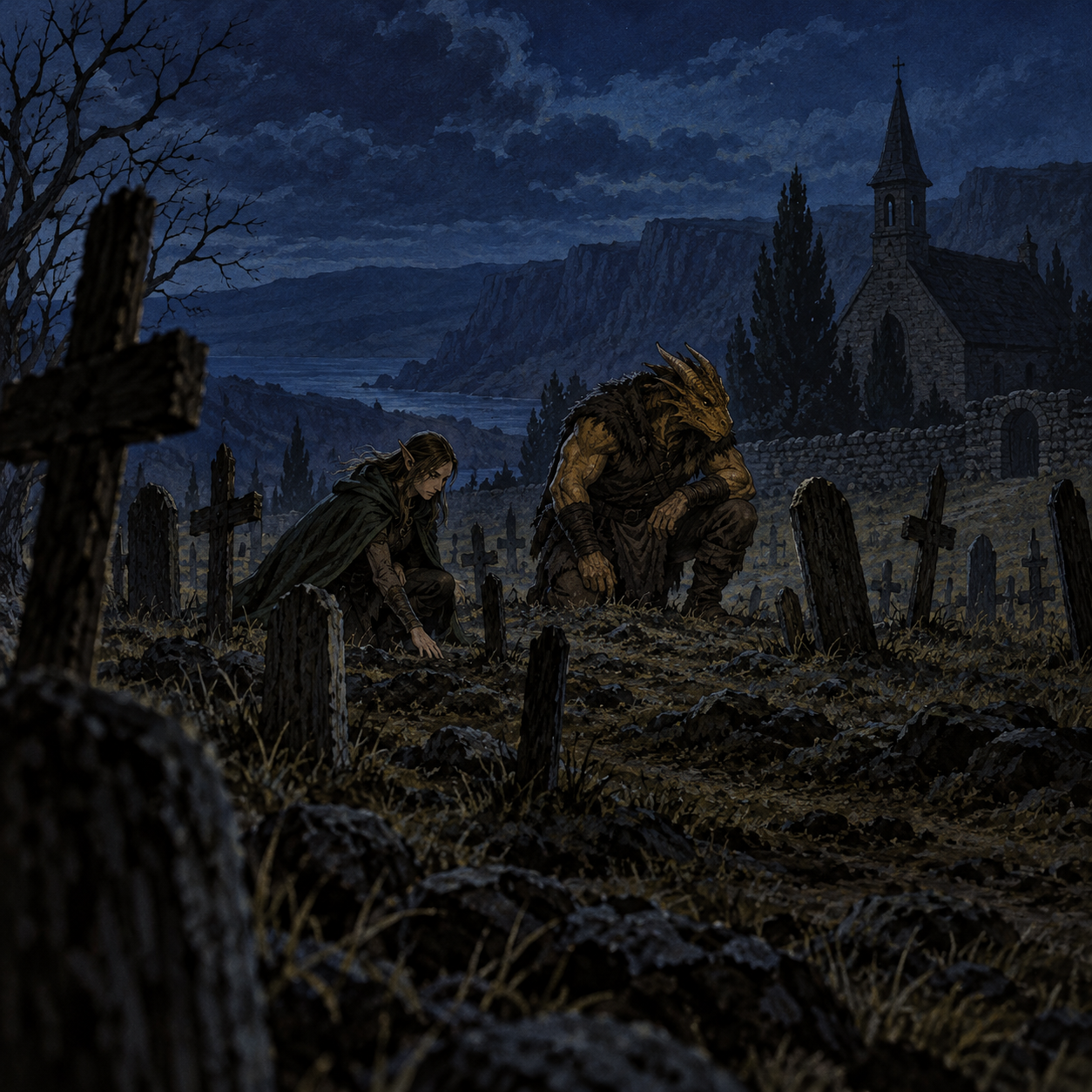
The graveyard looked different when Thorn came to search it for himself.
Earlier there had been a coffin to carry, a burial to stand through, the close demands of someone else’s grief. Now there was room to notice how far the graves ran behind the church, all the way out toward the cliffs. They wandered across the ground with none of the tidy order of soldiers on parade. Markers leaned. Some had all but surrendered their lettering to weather and years.
Maledurk moved beside him, a solid presence among the crooked rows. Thorn had suggested this. He reminded himself of that as he bent to read the first stone.
Near the church, the dead had dates of birth and death, and sometimes a few words from someone who had known what ought to be said. The burgomaster lay in this nearer stretch. Farther out, past a modest gap of open ground, another section began. In daylight the division had been easy to miss.
Here the names changed. They belonged to distant places, to people who had evidently arrived with titles and homelands still attached. Baldur’s Gate. The High Forest. These travelers’ lives had begun somewhere beyond the enclosing mists. Many of the markers were wood, with only a name cut into each one.
“They didn’t know much about these people,” Thorn said.
The graves were plain, but nothing about them suggested contempt. Someone had buried strangers and recorded what could be recorded. Standing among them, Thorn found that small effort more unsettling than neglect would have been.
He sent word to Elora as they went, a few clipped sentences at a time. Ratatouille was still trailing the procession. The ghosts had left the village and were keeping to the road. The mansion was quiet.
Thorn worked farther toward the cliffs, looking for markers the weather had not yet softened. The older graves gave way by degrees to newer ones. If their names were here, he reasoned, they would be among those. Then he came upon four markers standing together, and the search was over.
Thorn. Elora. Maledurk. Tempest.
He read them again, starting this time with Maledurk’s, as though the order might matter. It did not. There were more graves beyond these four, but he had lost all interest in them. He reached out and touched his own marker. The material felt ordinary under his fingers, neither luminous nor insubstantial. There was no shimmer to dismiss, no ghostly light seeping up from the ground.
“Well,” Maledurk said. “That’s interesting.”
Thorn would have accepted almost any other word. The earth was settled. These were not graves dug in anticipation of their arrival that afternoon. The markers were not badly worn, but neither were they new; they might have stood here a few years. There were no dates to help him. He sent Elora the four names, then stayed beside his own with nothing useful left to do but look at it.
He had been trying all evening to place this Barovia before or after the one they remembered. The graves refused both arrangements. The village repeated its familiar troubles; their hosts had forgotten them; their dead likenesses walked west while their living bodies stood over graves that had already had time to age.
“Perhaps it repeats,” he said at last. Maledurk looked over. “The village. The circumstances. Perhaps people come through and are put through the same thing.” Thorn’s gaze traveled across the bare names around them. “A challenge. A torment. Something Strahd made.”
Even as he said it he could hear how much he was asking the idea to carry. The villagers had seemed real enough. Their suffering had certainly needed real help. Elora’s answer came back through the magic: perhaps they were seeing what would happen if they failed to change it.
“A future that’s already been buried a while,” Thorn murmured.
There was no comfortable direction from which to come at it. Maledurk considered the ground in front of them. They could stand here, he suggested, and wait for somebody to climb out and explain what they were supposed to do. Nobody climbed out.
Elora had a more practical question. Was there actually anything in the graves?
Thorn looked down at the settled earth beneath his name. Until that moment the marker had been enough to occupy him. Now he found he wanted an answer to her question, and did not want it at all.
Maledurk’s coffin was too small.
That was the first good thing about it, and he had very little time to enjoy the discovery.
Elora had come from the mansion, leaving Ratatouille to keep pace with the ghosts. They were moving slowly; they could be caught if it came to that. For now there were four names in a graveyard and something under them she could reach.
“Whose first?” Thorn asked.
“Maledurk’s.”
Maledurk looked at her, but she was already calling on her magic. The earth shifted under its own weight and slid apart as though something buried were being gently unwrapped. Damp soil heaped itself beside the opening. Roots stretched from the edges. The smell came up rich and cold, and then the plain boards of a wooden coffin showed below.
It should have been an unpleasantly straightforward sight. He had a grave, and there was a coffin in it. But the size was wrong. Elora saw it too, and between them they got the lid off.
Bob lay inside.
Maledurk stared. The face was spoiled by death and time, but enough of it remained. The body still wore its clothes. This was no anonymous heap of bones onto which fear could press a familiar name. He knew who he was looking at. Bob belonged to Strixhaven, to the school, to a life they had learned was separated from their own by something like eight hundred years. Here he lay under Maledurk’s name, looking as if he had died within the twelvemonth.
Maledurk’s first impulse was to find something to say. Usually, given a moment, a remark turned up on its own. This time the moment stretched. “Bob,” he said finally.
Elora stood very still at the edge of the grave. They had seen Bob die. They remembered Ophelia dying too, and what had happened when they were raised: Maledurk and Tempest had come back in their place. That had been hard enough to hold in one’s head without a second Bob waiting under a wooden lid. Maledurk looked at his own hands, then back into the coffin. Whatever explanation turned up eventually, it would have to account for both.
“Tempest next,” Elora said.
She moved more earth, and they opened another plain coffin. Ophelia lay beneath Tempest’s name.
Elora did not stop for another round of guessing. “The other two. Let’s be sure.”
Maledurk helped where there was something solid to shift. It was a relief to put his strength into boards instead of standing uselessly over them. The coffin in Thorn’s grave held Krenn. Under Elora’s marker lay Luna, the fairy. That made all four.
Thorn stood over the body beneath his name with his mouth slightly open. There was no clever arrangement of the facts now that would leave one of them outside it. Their names marked the graves; the bodies belonged to the people they had been at the school; the ghosts on the road wore their present faces. And Tempest was elsewhere, alive as far as any of them knew, while all three of her somehow had a place in this one night.
Elora looked over what could be seen without pretending the looking would make sense of it. The clothes were intact and the bodies recognizable. They did not look eight centuries dead. “Within a year?” she said.
Perhaps. Maledurk had no better measure to offer. He tried to imagine being buried here, and memory handed him nothing. He tried to fit Bob’s face into the grave with his own name above it, and the two stayed stubbornly apart. At least nobody suggested that opening the coffins had solved anything.
“I don’t know what to do with this,” Elora said.
There was comfort in hearing her admit it. Not much, but enough to let him breathe properly again. Beyond the graveyard, the night went on without any help from them. The procession was still on the road, and Ireena was still in the mansion. They had meant to rest so they could walk her out in the morning.
Thorn finally looked away from Krenn. “We should go back.”
“And be there if the house is attacked,” Elora said.
Maledurk nodded. He could stand between a friend and whatever came through a door. A coffin holding another version of himself offered no such clear instructions.
They turned to go, then stopped over the matter of the open graves.
“We ought to put them back,” Elora said. “It would be polite.”
Thorn looked at the markers. “They are ourselves.”
That was as persuasive an argument as any they had heard all night. The lids went back. Elora’s magic returned the soil, filling each opening until the coffins were hidden again. The graves looked freshly disturbed now. That, at least, was a change whose cause Maledurk understood.
He lingered for one last look at his name. Then he followed the elves back to the house. There were no monsters at the doors, no fresh blows on the walls. The mansion took them in as quietly as it had let them go, and the rest of the night passed without an attack.
By morning Elora’s body felt rested. Her thoughts picked up exactly where they had left off.
Ratatouille had followed the ghosts all the way to Castle Ravenloft. She listened, and for a moment the mansion around her gave way to remembered stone: the castle’s vastness, its passages, the impossibility of knowing what waited behind the next door.
The procession had gone around the side of the castle toward the chapel at the back. Every ghost had gone in. Then, one after another, they had jumped and fallen through the stone floor.
“All of them?” Elora asked. “Including us?”
All of them. They had vanished about an hour before sunrise. Ratatouille had not followed them beneath the floor, but when Elora carried the account to the others, they remembered what lay down there.
“The crypts,” Thorn said.
And among those crypts, on their earlier visit, one had borne his name. Elora had nearly let that detail sink into the crowded heap of things Ravenloft had done to trouble them. Now it came back with the unpleasant freshness of a hand closing on her wrist.
“We went inside that one, didn’t we?”
“Yes.” Thorn frowned. “It was empty, as I remember.”
She remembered it that way too. An empty crypt in the castle, a body in the village graveyard, and a ghost walking between the two. If the procession had come from the graves at all, that was. They had only seen it approaching from the direction of the church. The castle lay beyond the cliffs in roughly that direction as well, though climbing down from it that way would have been another matter.
“We don’t know where they came from,” Thorn said. “Now we know where they went.”
They had not found the others’ names among Ravenloft’s crypts, but they had not opened every crypt. That omission, perfectly reasonable while they were inside the castle, now gave them one more thing to speculate about.
“Perhaps Strahd was trying to frighten us,” Thorn said. “Putting a name there before it was needed.”
Elora pictured the slow procession dropping into stone. “He’s a vampire. They were back before daylight. Could they all be people he…” She stopped. Following that thought meant making their own likenesses part of it.
“I did want my steak very rare,” Thorn said. “Only warmed, really.”
Maledurk’s expression gave him nothing to work with. The joke left the question where it stood. Ghosts did not become vampires simply by walking to a vampire’s castle, and nothing they had seen explained why their own faces were among them.
Ravenloft was close enough to reach in a day’s walk. They could go. They had been inside before; they knew something of its dangers. Maledurk still carried the Sun Sword he had struck Strahd down with.
That memory ought to have steadied her. Instead it left her wondering what they had missed. They had fought him, used their magic to pin him, and Maledurk had delivered the blow. Then the world had begun to shake and come apart, and they had left with the urgency such circumstances encouraged. No one had stayed behind to make a careful examination of the body.
“We never made certain,” Thorn said.
They could go back to the castle and try. Elora looked toward the room where Ireena was getting ready to leave.
Thorn could almost feel the pull of the castle road.
There were mysteries one could carry for years because there was no useful way to approach them. This one had obligingly marched past the window and handed them a destination. His name was written in two places where people put their dead. He wanted to know why. The idea of simply walking away from it set his teeth on edge.
“We could investigate Ravenloft more thoroughly,” he said.
Elora listened. Maledurk had the sword. The three of them had survived the castle once, though Thorn could not decide whether that counted in their favor when their ghosts were apparently still visiting it. And the way to Vallaki ran in the same general direction, which made a diversion feel smaller than it was.
“Are we taking her to Vallaki,” Elora asked, “or to Ravenloft?”
Put like that, it was a remarkably poor proposal. Thorn glanced toward the stairs. They had come back to this house because Ireena needed help. Nothing dug up in the graveyard had made that need any less urgent.
Vallaki was more than a day off. They could not deliver her there, inspect the castle, and call it one tidy errand. One task would have to wait.
“We said we’d take her,” he said.
They had said it before, too. On their earlier visit, the castle had drawn them off almost at once. He rubbed a hand across his face.
“Why don’t we follow something through this time and finish it?”
“All right,” Elora said. “Vallaki.”
His doubts remained, but it was a relief to have decided what to do. The ghosts would keep. For now, there was someone upstairs who expected them to keep a promise.
Ireena came down in armor. The dress they had first seen her in had made it easy to think of her only as someone besieged in a house. The sword at her hip required an adjustment. Thorn looked from it to the armor and asked whether it marked some rank.
“No,” she said. “I’ve been trained to fight.”
She was ready to walk with them, and to defend herself if it came to that. After the night they had had, Thorn appreciated the plainness of it. She looked better for having slept. There was still weariness in her, but less of the drawn exhaustion they had noticed before. Weeks of attacks would have explained that on their own. Elora remembered another reason to worry.
They checked her neck. The bite marks were there, just as they had been on the earlier visit.
Thorn’s attention came fully back to the journey. Strahd had bitten her twice. From what they knew, a third separate occasion would complete the change; she was not yet a vampire. But the bites had already made a connection. He could use it to sense where she was. Leaving the village would not simply hide her.
Elora’s eyes went to the road. “So he can follow us.”
The hope of Vallaki rested on more than distance. Ireena and Ismark believed the Vistani there had some protection, some magic that could keep Strahd at bay. The Vistani could leave Barovia and come back as they pleased. Whether that freedom meant they could shelter Ireena remained to be discovered. It was still the best destination they had agreed on.
Ismark said his goodbyes at the house. He was staying with the villagers, taking up what his father had left behind. Thorn gave him room with his sister, then checked that everything was ready.
The three companions set out with Ireena in the morning light. Their own ghosts had taken this road only hours before. Thorn caught himself studying the dust for a difference, some pale residue among the ordinary footprints. There was nothing he could pick out.
As the village fell behind them, Elora found herself thinking about the children.
The thought began with Ireena. Strahd’s pursuit had never been a mere preference for one victim over another. They had learned before that she closely resembled his dead wife, and that he believed his wife’s soul lived on in her. His belief was not proof, however violently he insisted on it.
Ireena’s own beginnings offered little help. She had been found beside the road near the forest and raised by her adoptive family. She remembered no life before that.
Then there were the two children from the house on the island: a boy and a girl, both ghosts. Elora tried setting their story beside Ireena’s, looking for an edge that matched.
It would not fit. The children had belonged to the family in that house. The girl had looked nothing like Ireena. The threats from Strahd they had found there suggested trouble between him and the household, but gave no reason to make the children his kin.
She said as much aloud, reluctantly letting that arrangement go. Thorn walked a while before he answered.
“There are stories,” he said, “about children showing someone a dangerous future.” Elora looked over. “Or leading them to a choice. Sometimes they don’t seem to be doing it at the time.”
He turned the old tales over as they walked. Two children at a crossroads; an encounter that looked small until everything afterward hung on it. In some stories the easy path led to ruin. In others, an act of charity turned the traveler’s fortune. None matched what had happened to them exactly.
“The children didn’t lead us anywhere,” Elora said.
“No. But we went into the house because they were outside it.”
She remembered the island’s barrenness, the hill with the house on it, so out of place on their voyage south. It had the look of Barovia about it, though they had not understood the resemblance then. By the next morning it was gone. They could have sailed past. Instead they had seen children who seemed to need help, and gone inside.
Thorn was looking down the road, his expression intent. “Perhaps that was the choice.”
Perhaps. After it had come Chult, the jungle, the ancient city, the lich. They had returned for the celebration a year later, and a dinosaur race had become the occasion of their being pulled into Barovia. A great many events could be strung between two points once one knew where the string ended.
Still, she could not quite dismiss it. “Helping them might have drawn Strahd’s attention,” she said.
“Or someone wanted to know whether we would help.”
“Whether we were people worth bringing here?”
“To save it, perhaps.”
Neither spoke for a few steps. The idea was tempting in its way. It offered an explanation for what had been done to them, and a reason better than someone’s amusement. Elora distrusted how welcome that made it. They did not know what would have happened had they ignored the house, or who, if anyone, had arranged for it to be there.
And the children had been dead. Their need did not become less real because helping them might have served another purpose.
Beside her, Ireena walked with her sword at her hip. Ahead, Maledurk kept the pace. Thorn’s speculations came by fits and starts, with room between them for the sounds of travel: boots, gear, the occasional scrape of loose stone. Elora listened. There was nothing more to be proved by talking, but she was glad of their voices after the silent procession.
By midday they came within sight of an encampment beside the road, near the river. The water moved beyond it, carrying the pale light in broken strips. Maledurk slowed as the camp came into view, and the others drew up with him.
Vallaki was still ahead. Ireena stood beside them in her armor, and the camp waited at the edge of the road.
The mansion: a dawn departure planned Elora, Thorn, and Maledurk returned from the village church to the burgomaster’s mansion. Their restoration and questioning of the priest’s son had taken place during the previous session; their next commitment was escorting Ireena to Vallaki. The late burgomaster was now buried in the churchyard, fulfilling Ireena’s condition for leaving. His grave lay among the local burials nearest the church. Tempest remained at Veyr’s tower, leaving the three companions in Barovia to undertake the escort. Familiar encounters continued to raise questions about when they had arrived. The companions remembered the townspeople and the earlier tavern encounter, but those people did not appear to remember them. Familiar faces looked essentially unchanged. The haunted house was absent this time, providing a difference between visits without establishing whether the present Barovia came before or after their earlier experience. The companions could recognize the repetition without explaining it. They recalled that Veyr’s travel could involve other planes and potentially other times, but no particular temporal destination explained this arrival. Their previous experiences remained useful as warnings and leads, rather than a dependable sequence of events they could expect to repeat. Ireena’s request nevertheless gave them an immediate task they could pursue while the larger questions remained unresolved. It was late afternoon when they reached the mansion, and Vallaki was several days away. Thorn recommended staying overnight: a few hours of evening travel would accomplish little before darkness, whereas leaving at dawn would give them a full day on the road after resting. Elora and Maledurk agreed. Their hosts provided rooms, and the party settled in for the night before the planned departure. Outside the mansion: a procession of adventurers Around midnight, two companions noticed shuffling footsteps outside, and all three subsequently watched the street. No one was banging on the mansion’s walls or doors. A dim green-white glow revealed a procession approaching from the direction of the church and graveyard. Roughly two hundred figures passed the house, continuing through the village without turning toward it or attempting an attack. The marchers resembled many small adventuring companies. Humans, dwarves, elves, and dragonborn appeared among armored swordsmen, bow carriers, and robed spellcasters. Their varied equipment distinguished them from villagers or a uniform army. Elora recognized their ghostlike appearance. The light came from the figures themselves, yet their passage also made audible footsteps and stirred dust beneath them. Closer observation revealed four familiar figures near the rear: two elves and two dragonborn resembling Elora, Thorn, Maledurk, and Tempest. These doubles wore the companions’ ordinary adventuring clothes and carried their usual equipment, with weapons stowed. They resembled the company’s present forms, including Tempest despite her absence at Veyr’s tower. Who or what these likenesses actually were remained unknown. Elora, Thorn, and Maledurk went outside and tried speaking to the marchers or otherwise attracting their attention. None turned or responded. Their expressions remained distant and unfocused, without evident pain, conversation, or readiness to fight. The procession continued past them. Thorn considered whether the doubles might be an omen of a fate they should avoid; other possibilities included another history or a possible future, but contact yielded no explanation. The figures turned west onto the road serving Vallaki and Castle Ravenloft. That did not match the companions’ earlier escape from Barovia, which had taken them eastward. Nor did it reproduce their previous approach to Ravenloft: they had flown toward the castle from the church. Elora wanted to follow the procession and discover its destination. Thorn proposed searching the churchyard for graves bearing their names, investigating the direction from which the figures had approached. Elora pointed out that Ireena might need protection if attacks resumed. Tempest could not stay behind as a guard because she was still with Veyr. Elora therefore initially remained at the mansion with Ireena, while Thorn and Maledurk went to search the cemetery together. This allowed the graveyard investigation to begin while someone from the party stayed close to the person they had promised to protect. Elora also sent Ratatouille after the procession, using her ability to see through his eyes. The marchers ignored him just as they had ignored the adventurers. He followed them out of town while Thorn and Maledurk investigated their other lead. His assignment was to trace the figures’ route and destination; the pair at the cemetery would look for a connection between the companions’ names and the village’s burials. The churchyard: four familiar names Thorn and Maledurk’s Investigation checks helped them search the large, irregular cemetery extending from the church toward the cliffs. They distinguished local burials near the church from a farther section belonging to outsiders. The local graves often had stone markers, dates, and epitaphs. Many outer markers were simpler and wooden, recording foreign names and places of origin but generally lacking birth and death dates. The burgomaster’s grave was in the nearer section. Thorn reasoned that more recent graves might lie farther out. Following that apparent progression, they found a cluster marked Thorn, Elora, Maledurk, and Tempest. Additional graves continued beyond it. These four were not freshly dug, and their relatively unworn markers looked perhaps a few years old. Without dates, their condition supplied only an approximate impression of age. All four current names nevertheless appeared together among the outsiders’ burials. The cemetery looked ordinary and physical, without the procession’s green-white glow. Thorn kept Elora informed through magical messages while she remained at the mansion. Ratatouille continued following the slow-moving figures along the road and across a bridge, and nothing further disturbed the house during this interval. The party discussed warnings and alternative histories, but the markers alone did not explain the discovery. Elora decided to join the pair and inspect what lay beneath them. Elora used earth-moving magic to uncover the grave marked Maledurk. Beneath it was a simple wooden coffin, smaller than the present Maledurk. Opening the coffin revealed Bob, his Strixhaven student identity. The burial therefore connected a current name to a former student body. Elora had the remaining graves uncovered as well, checking whether the same pattern extended to the other three companions rather than stopping at the first coffin. The other burials completed the pattern: Tempest’s grave contained Ophelia, Thorn’s contained Krenn, and Elora’s contained Luna, her fairy student identity. All four bodies were recognizable and still clothed rather than reduced to skeletons. The distinction from the procession was clear: the marching doubles resembled the companions’ present adventuring forms, while the coffins contained their former student selves. The discoveries encompassed the whole company, including the absent Tempest. The bodies’ condition suggested that death within roughly the last year was possible, though it established no exact date. That apparent recency conflicted with the account placing the Strixhaven student adventure some eight hundred years earlier. Neither the remains nor the relatively unworn markers explained the discrepancy. The companions also recalled Elora’s intervention through the crown, in which Bob and Ophelia had returned as Maledurk and Tempest. The bodies’ presence in Barovia added another unresolved piece to that history. The party could not explain when or how these students had been buried here, or how the bodies related to the living companions and their ghostlike doubles. They chose to cover the graves again. Elora agreed, saying, “Yeah, I guess it would be polite.” Her earth-moving magic returned the soil within a few minutes. Everything was back in place, although the ground remained visibly disturbed. They took neither bodies nor grave goods away with them. Elora, Thorn, and Maledurk returned to the mansion to rest and remain available if Ireena needed protection. Ratatouille continued following the procession after their cemetery investigation ended. The house remained quiet, and no attack interrupted the remainder of the night. The companions had left the four burials restored and their contents in place, with Ratatouille’s continuing surveillance still offering a chance to learn where the marchers went. Morning at the mansion: Ravenloft can wait The three travelers woke early, fully refreshed after completing a long rest. Ratatouille reported that the procession had followed the road to Castle Ravenloft, gone around to the chapel at the rear, and entered it. Roughly an hour before sunrise, every marcher—including all four doubles—had jumped or dropped through the chapel’s stone floor and disappeared. His report traced the figures to a specific part of the castle. Ratatouille had not followed them below the floor into the crypts. Their origin also remained untraced: the companions had seen them approaching from the church’s direction, but no one had seen them rise from any village grave. The chapel provided a destination to investigate without revealing which chamber, if any, the figures reached beneath it. Whether the procession repeated on other nights was likewise unknown. The report recalled an earlier discovery beneath Ravenloft’s chapel: a crypt bearing Thorn’s current name. The companions remembered it as apparently empty, although their recollection of its contents was tentative. They had not found corresponding crypts for the others, but neither had they examined every crypt. Thorn wondered whether his named chamber had been intended to frighten him or reserve a place for him. Its relationship to the newly discovered grave containing Krenn remained unexplained. They also reviewed their earlier confrontation with Strahd. Magic had contained him before Maledurk struck him down with the Sun Sword, which Maledurk still possessed. Thorn emphasized that they had never inspected the body to verify a lasting death. Their surroundings had begun shaking and apparently falling apart, prompting their escape. The remembered victory therefore left Strahd’s permanent destruction unconfirmed, while the sword remained an available resource that had proved effective against him before. Thorn initially favored returning to Ravenloft because the chapel and crypts might illuminate the new discoveries and the larger mystery of their travels. The castle lay broadly in their intended direction, but not directly on the Vallaki route; walking there would take most of a day. They considered a fuller castle investigation and the alternative of leaving Barovia for Veyr’s tower, alongside the escort already promised to Ireena. No new expedition began during this discussion. Thorn ultimately argued for honoring that promise: “so why don’t we follow something out this time and finish it?” Elora explicitly confirmed that they would take Ireena to Vallaki. The castle investigation could wait, with no date set for a return. This choice advanced the escort that had remained unfulfilled during their earlier visit. Rested and still carrying the Sun Sword, the companions prepared to leave with Ireena rather than divert toward Ravenloft. Leaving Barovia: Ireena’s protection and Strahd’s connection Ismark said goodbye and stayed behind to work with the villagers as the new burgomaster following his father’s death. Ireena departed with Elora, Thorn, and Maledurk. With the burial completed and the party’s decision made, the planned escort became an actual journey. Ismark would remain responsible for work in the village while his sister traveled toward the refuge they hoped Vallaki could provide. Ireena emerged in armor and carrying a sword, unlike the ordinary dress she had worn when first met. Asked whether this signified royalty, she denied it and said she had been trained to fight. She joined the travelers equipped to defend herself, although no combat tested her training during the journey that followed. A full night’s sleep had improved her appearance after the weeks of attacks that had left her tired. Elora examined Ireena’s neck and found the same bite marks the companions remembered. Her covered neck had previously prevented inspection during this visit. Ireena had been bitten twice; full transformation into a vampire required bites on three separate occasions. She had therefore not become a vampire. No new bite occurred during their departure or this stretch of travel, and none of the traveling companions suffered new damage or injury. The existing bites nevertheless gave Strahd a connection through which he could sense Ireena’s whereabouts. Elora recognized that moving her out of the mansion would not itself prevent him from locating her. The party had no established method of breaking that link. The escort’s safety therefore depended on more than putting distance between Ireena and the village, making the protection hoped for at their destination a significant part of the plan. Ireena and Ismark believed that Vallaki’s Vistani inhabitants possessed magic or protection capable of keeping Strahd away. That belief explained their choice of refuge; the adventurers had not verified its safety or learned how the protection worked. Vallaki was a Vistani town, and the Vistani could leave Barovia and return freely. The companions continued toward it with the hoped-for protection still untested. Their discussion also revisited Ireena’s resemblance to Strahd’s long-dead wife. The party understood that Strahd believed Ireena carried his wife’s soul, but that belief did not establish her identity or reincarnation. Ireena’s own origins remained unknown: she had been found near a forest road and adopted into the burgomaster’s family. Neither that history nor the resemblance explained how to free her from the connection created by his bites. The west road: old choices and a riverside camp While walking, Elora looked for a connection between Ireena’s story and the wandering haunted house’s children. The companions remembered a boy and a girl, ghosts belonging to the family that had lived there. The girl had not resembled Ireena. They also recalled threats apparently made by Strahd against the household. None of those memories established that the children were Strahd and his wife, or Ireena and Ismark; Ireena’s unknown early history supplied no demonstrated family connection. Thorn wondered instead whether paired child ghosts could signify a warning or a choice affecting the future. At Elora’s suggestion, a History check brought related legends to mind. In those stories, children or child ghosts guided someone toward a life-changing decision: an ordinary or familiar path might lead to ruin, while a difficult, charitable, or valorous choice could change the outcome. No particular legend matched their experience exactly. The companions reflected that helping the children had been their reason for entering the house; they had possessed no other practical need to go inside. That voluntary act of assistance resembled the choices described in the legends. They considered whether it had marked a turning point, perhaps attracting Strahd’s attention or testing their suitability as potential helpers for Barovia. Those remained theories, without establishing the children’s motives or what would have happened had the party ignored them. They reviewed the order of their earlier adventures to place that possible turning point. The island-house encounter had occurred during the voyage to Chult, before the jungle expedition and battle with the lich. Their first displacement into Barovia came later, during the anniversary visit and dinosaur race in Port Nyanzaru. Helping the children thus preceded their arrival in Barovia, with the Chult adventures intervening; the proposed connection stretched across that history rather than linking two immediately successive events. They also recalled the island more precisely: small and barren, essentially a hill with the house on it in warmer southern seas. The building’s architecture had seemed markedly out of place, and it had vanished by the following morning. Its later appearance in Barovia, followed by its absence on the current visit, kept it relevant to their questions about unexplained travel. Its present location and the reason for its appearances remained unknown. Around midday, Elora, Thorn, Maledurk, and Ireena reached or came within sight of an encampment beside the road and river. They were still traveling out from the village of Barovia; Vallaki remained several days away. The camp’s name, inhabitants, and affiliation were unknown. The session ended before any conversation or further action there, leaving the travelers at the newly encountered riverside encampment with the escort underway.Session Notes