The puddles trembled before Maledurk reached them.
Elora watched the rings spread across the black water, one inside the next, and then lifted her eyes to the foot coming down beside the road. Mud squeezed up between the tyrannosaur’s toes. Somewhere far above her, a head large enough to take a respectable bite out of a wagon swung toward the trees.
For once, nothing came out of them.
She had already shed the bear. Her own skin had given her back certain conveniences: hands, speech, a proper appreciation of how filthy her clothes had become. It had also given back the weariness underneath. The road to Vallaki had offered lightning, werewolves, and wagons with an unhealthy interest in eating travelers, and it was still offering several more miles. Maledurk might as well enjoy what was left of his time as something larger than the road’s problems.
“Are we there yet?”
It had been asked often enough by now that no one bothered answering. Ahead, Thorn studied the dark as if a town might be persuaded to appear through sheer concentration.
“We could bunch together,” he suggested. “Swords out. Move as a group.”
Elora pictured the procession: a bristling knot of exhausted adventurers shuffling along beneath a tyrannosaur. Anything inclined to attack them might at least pause to appreciate the spectacle.
They went on with Ireena between them. The trees stayed trees, and the road stayed where it belonged. After the evening they had endured, Elora found both developments encouraging.
Eventually the great tread behind her stopped. Maledurk was himself again, brass-scaled and a good deal nearer the ground, and the puddles settled. They walked the rest of the way on an altogether less impressive number of ordinary feet.
Vallaki came out of the dark before dawn: walls first, then iron bars across the road, then two guards on the far side of them. Elora stopped in front of the gate and let herself look at it. She knew too much about what was loose in Barovia to mistake masonry for a promise. Still, someone had built this, and kept it up, and put people here to watch the night.
“Why are you traveling at this hour?” one of the guards asked.
Thorn explained who they were and why they had come. The guards wanted to know how long they had been on the road. They asked enough questions that Elora started to hear the one underneath: whether Strahd had sent them.
There was also an inquiry about fresh fruit. She was too tired to decide whether it belonged to the same investigation.
At last the gate swung open. The guards pointed them toward the Blue Water Inn in the middle of town, and they passed into quiet streets. Here and there a door opened and someone stepped out to begin an early trade. Most of the houses stayed shuttered. After the road, their own footsteps sounded indecently loud.
The inn was a big wooden building of two stories, a blue waterfall painted on its sign. Inside, the common room opened upward to a gallery. Empty tables stood before a bar at the back, and from somewhere beyond it came the small, purposeful sounds of a kitchen beginning its day.
The man arranging things behind the bar looked up.
“Breakfast won’t be ready for about an hour.”
“We’re here for information,” Elora said.
“And rooms,” Thorn added.
“Rooms I’ve got. Information depends on the question.”
It was the most sensible assurance anyone had offered them in some time. Most of the town was still asleep, the innkeeper said; if they wanted to question it, they would have to wait for it to wake.
He sent them upstairs and along the hall. Elora proposed going up in pairs, a small precaution that felt reasonable even here, behind walls and under a roof. Her body had not yet accepted that the journey had paused.
The bed helped persuade it.
By late morning, Thorn could think without feeling that every thought had to be hauled uphill.
Rest had restored his attention to its usual troublesome reach. There was still a crown to understand, and the powerful creature it had belonged to, and the larger matter of why their lives kept being uprooted and flung into places like this one. For the moment, though, Ireena had a practical destination. She wanted to see the burgomaster. Her family knew his; surely that would count for something when she asked for refuge.
“We should take her,” Elora said. “And he ought to know what’s happening in his own town.”
Thorn agreed. It was a reasonable place to begin, even if people who ought to know things had proved an unreliable source of them.
The mansion stood at the end of a cul-de-sac, a large stone house with its plaster fallen away in patches. People worked among the shrubs and trees in the grounds. Others came in from the street carrying bundles of sticks, added them to growing piles, and went away again. A guard watched from the door with the look of a man for whom an accumulating quantity of twigs had long since stopped being interesting.
Ireena gave her name. The guard knocked, a servant admitted them, and they were shown into a sitting room to wait. Baron Vargas and Baroness Lydia received her together.
“Thank you for seeing me,” Ireena said. She laid out the trouble in the village, Strahd’s pursuit of her and her family, her hope of finding shelter in Vallaki.
The baron asked after her father. Thorn watched her answer. There were questions one could brace for and still be hurt by when they came.
“He died a few nights ago. The attacks, the strain of them, were too much.”
The baron and baroness offered their condolences, and for a moment the sitting room held nothing but that ordinary exchange of loss and sympathy. Then their attention shifted to the strangers who had brought her.
“And who are these people?”
“Some weirdos I met in the street,” Ireena said.
Thorn could hardly object. The description omitted their better qualities, but it had the merit of brevity.
“We brought her here safely,” Elora supplied. “A merry band of tyrannosaurs.”
Vargas asked whether the journey had been difficult. They mentioned the werewolves, and the wagons that had turned into hungry things. Neither he nor Lydia looked particularly startled, which Thorn found more disquieting than alarm would have been.
“The roads are dangerous for visitors,” the baron said. “Within Vallaki, you will be quite safe. We hold back Strahd’s minions. He does not dare act against the town himself.”
Elora asked about the creatures so near the gates. Vargas allowed that there were wolves and other things in the woods, occasional dangers that had to be kept out, but denied that the town suffered anything deliberate or sustained.
Thorn thought of the iron gate. He had been grateful to pass through it. Gratitude did not oblige him to believe a fence had settled the matter of Strahd.
Elora turned the conversation toward their own search. There was a crown whose ownership and history troubled them. Perhaps the baron had something in his house that might shed light on it.
Vargas seemed unsure what sort of help she expected. He could offer nothing to protect them on the roads. The Vistani traveled safely; if travel was their concern, they might speak to the Vistani. But what, precisely, were they looking for?
They had reached the point where a guarded answer would only buy another guarded answer. Thorn glanced at his companions.
“I don’t see much advantage in keeping it secret,” he said. “If we tell people what we’re trying to do, someone may know enough to help.”
“And someone unpleasant may hear about it,” Elora said.
“Yes. But we might find allies as well.”
He had little appetite for wandering from settlement to settlement clutching their unanswered questions like valuables. If some greater wrong lay behind what had happened to them, they would not correct it by making themselves incomprehensible to everyone they met.
“We need to find out what’s wrong,” he went on. “Here, elsewhere, all of it. If people are being threatened, or made to pay for being left alone, that matters. We ought to ask.”
“You go make noise,” Maledurk said. “We’ll wait here.”
Thorn gave him a look. Maledurk’s expression did nothing for the dignity of the proposal.
But Elora agreed, and no one else objected, so they told Vargas and Lydia the broader story: the crown, the creature associated with it, the extraordinary things that had happened to them, and their effort to learn who or what lay behind it all.
The baron listened.
“It sounds very fanciful,” he said at last.
Thorn considered how much fancy had been required to survive the previous night.
“Are you oppressed here? By Strahd, or anyone else?”
“No. We live quite comfortably compared with other places in Barovia.”
Vallaki’s safety, Vargas explained, rested on an ancient pact their ancestors had made with Strahd. By his account, those within the walls were left alone; anyone who ventured outside remained at Strahd’s mercy. The walls kept out the dangerous creatures that sometimes wandered close. The pact was the reason the town endured.
That was the kind of explanation Thorn had been looking for, though the baron’s comfort with the arrangement gave him pause.
Vargas described Vallaki as a town founded by Vistani. Its settled people shared that ancestry and its protection, he said, though others preferred the old wandering life. A camp of travelers lay west of town. They stayed a few weeks at a time before moving on, and might have histories or knowledge he lacked. There were stories of fortune-tellers among them. He did not visit them himself. He preferred to remain inside the walls.
Within Vallaki, he recommended St. Andrew’s Church on the western side of town. It was older than the town itself; the priest might know something useful about the past. The Blue Water Inn was another possibility, with travelers staying there who might have heard something.
“You are welcome to our hospitality and protection,” Vargas concluded, “provided you cause no trouble.”
Thorn could see no particular contempt in the man. The baron spoke of the people and places around him as though they were features visible from a comfortable window, and his interest did not seem inclined to go out and meet them.
They had brought Ireena into Vallaki and stood beside her while she asked for refuge. That much was done. Their own search had gained three possible directions, none of them inside this sitting room. Still, Thorn was not quite ready to leave.
“This is a remarkably interesting house,” he said. “Beautiful, too. Could you show us around before we go? Tell us about some of the objects, the paintings, perhaps?”
He let his gaze travel appreciatively over the room.
“Such a reflection of its owner.”
Elora had heard Thorn talk his way through a great many things. She was still impressed by the ease with which he had just invited a man to explain his own good taste.
Vargas obliged.
The entryway held more bundles of sticks. In the corridor hung portraits of ancestors, each of whom required an account of his place in the succession. There was the baron’s father, and his grandfather, and his great-grandfather, and beyond them further generations waited, apparently equipped with the same inexhaustible claim on their descendants’ attention.
Elora let her awareness reach for magic as they walked. She felt for the familiar sense of something laid beneath the surface of the visible world: an enchantment in an object, a spell clinging to a threshold, some small disturbance to justify her curiosity. Nothing answered.
Beside her, Thorn was beginning to suffer the consequences of his request. His attentive nods had acquired a dangerous regularity. Once, as Vargas turned toward another portrait, his eyes closed for a fraction too long. Elora nearly smiled. Then the baron began on another relation, and she found she had to concentrate on keeping her own face awake.
They saw the dining room, the kitchen, and another room the family used. Stairs led upward, but Vargas did not take them there. The sleeping quarters, he explained.
“And the sticks?” Thorn asked, seizing on something that was neither an ancestor nor a room.
“For the Sun Festival.”
The townspeople gathered the wood and brought it here to build a great wicker sun. That was the festival for the week. Vargas delivered the explanation with a dour seriousness that made the festivities hard to picture.
“The common people believe happiness protects them from evil,” he said. “From Strahd. They think the celebrations keep him away.”
His face remained entirely untouched by the subject under discussion.
“They are mistaken, of course. But it keeps them entertained. I see no reason to discourage it.”
Elora thought of the people outside, bringing their bundles in through the gate. She had seen their work before she heard its explanation. Now she wondered how they would have explained it themselves.
The tour delivered them back to the front door. They thanked their host and went out. Once they were clear of the entrance, Elora drew the others together.
“I think there’s something in that house.”
Thorn looked back at it. “You didn’t find any magic.”
“No.”
“But you still want to look.”
“Yes.”
The absence of magic had not satisfied her. Neither had being shown a carefully ordinary set of rooms by a man who could speak about his great-grandfather more readily than about the people living around him. It was a suspicion, nothing more. She knew that. She also knew how often a closed door had mattered.
“We asked to look around,” she said. “We’ve seen what he wanted us to see.”
Thorn considered the house a moment longer.
“I could go back invisible.”
Elora turned toward him with immediate interest.
“A quick look,” he added. “Upstairs. Provided I can get through the door.”
“That sounds like an excellent idea.”
He regarded her with the resigned expression of a man who had made his own trouble twice in one morning.
The mansion was busy enough to make invisibility useful and movement difficult.
Thorn threaded the ground floor among servants cooking and cleaning, going about the ordinary work of a large house. Doors opened without warning. He kept clear of elbows and trays and the paths people took without looking because they had taken them a thousand times before.
Everything downstairs was much as Vargas had described it. That proved nothing about upstairs, so he climbed.
Bedrooms opened off the upper passage. One held a mirror and a dressing table. Another door was locked. A second staircase at the back ran down toward the kitchen, a servants’ route between floors.
Near the burgomaster’s office he found an unlocked room with manacles fixed to the wall.
He stood in its doorway a moment. No one was inside, and the iron offered no explanation beyond its obvious purpose. The burgomaster was the town’s authority; perhaps prisoners waited here before being brought before him. Thorn could imagine other reasons to chain someone in a country where a person might become a wolf. He could also imagine worse ones. The empty room did not distinguish among them.
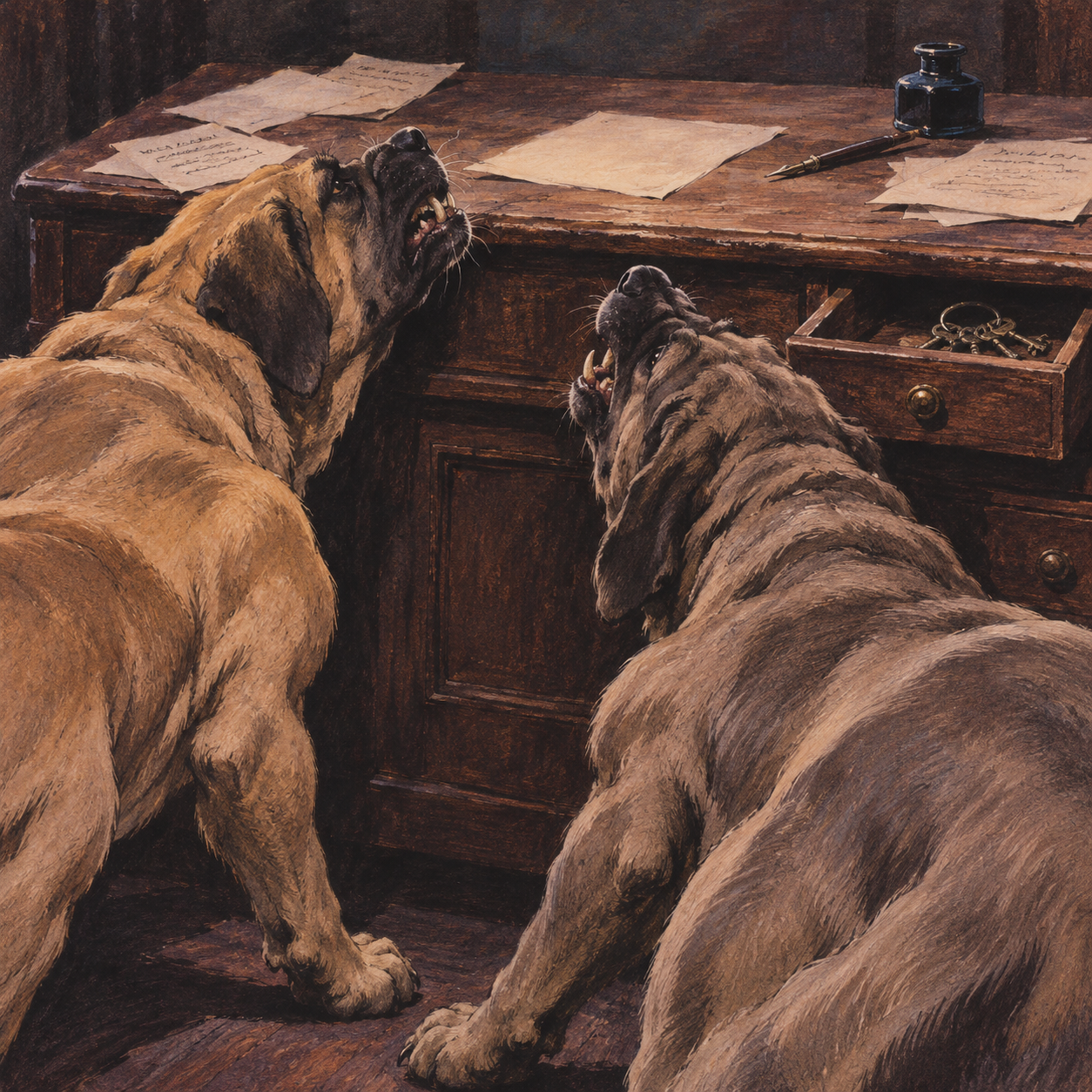
He moved on to the office, where two enormous mastiffs lay asleep.
Their heads came up when he opened the door. Thorn went still. The dogs looked toward the opening, saw no one, and gradually lowered their heads again. He entered with care, only for the floorboard under his foot to let out a long, appalling creak.
Both dogs rose. Thorn looked at the desk, judged the distance, and leapt onto it.
One mastiff’s head followed the movement almost exactly.
That was discouraging.
The dogs sniffed. Their noses worked at the air below him; then a low growl began, and they approached the desk with a purpose that did not require clear sight.
Thorn crouched among the papers and reviewed his available talents. Most of the decisive ones would be excessive in a burgomaster’s office. Lightning would solve the immediate problem at the cost of several much larger ones. He would have preferred a bone, had he possessed one. He wondered briefly whether an unseen hand scratching behind an ear might settle a suspicious mastiff, looked at the size of the nearer dog’s jaw, and abandoned the experiment before conducting it.
The papers under him were mostly blank. A few carried the beginnings of a decree about the Sun Festival. There was a pen and an inkpot, neither likely to explain the crown or discourage a dog. There were also drawers.
Since he was already here, and since leaving was becoming an undertaking in its own right, he extended a foot over the edge and worked a drawer open with his toe. A ring of keys lay inside.
Thorn looked toward the doorway, then down at the dogs. He retrieved the keys with as little noise as he could manage, his whole attention narrowed for a moment to keeping metal from touching metal. Below him the mastiffs sniffed and growled at the space he occupied. He needed them interested in something else.
A steak appeared on the floor behind them.
It was an excellent steak, insofar as an illusion could be excellent, and both dogs hurried toward it with an enthusiasm Thorn found deeply reassuring. He dropped from the desk, crossed the room, and pulled the door shut behind him.
Something moved on the other side. He held the latch a moment longer than necessary, listening. Large as they were, the mastiffs did not appear to be equipped for doors. He let out his breath.
Across the passage, the locked room waited. One of the keys fit.
Inside were dolls.
They stood along bookshelves and on shelves mounted to the walls. They crowded the bed in the corner and covered the top of a heavy wooden chest. Some wore elaborate dresses; others were plainly clothed. All of them had powdered-white skin and auburn hair.
Thorn’s hand stayed on the door as he looked from one face to another, and another.
Ireena.
The differences in their clothing only made the sameness more exacting. A fine dress, a simple dress, another arrangement on another shelf: each offered him the face of the woman they had brought here seeking safety.
For several breaths he forgot the dogs. Then he drew the door farther closed behind him and began to examine the room.
The dolls suggested a child’s room. Almost everything else complicated that first impression. Empty wine bottles stood about, their labels naming the Wizard of Wines and Purple Grapemash Number Three. In the chest he found a heap of ordinary men’s clothing, shirts and trousers, and beneath it an unremarkable sword. He did not know whose room this was.
He lifted one of the dolls carefully. A tag stitched into its clothing read: Is no fun? Is no Blinsky!
Another bore the same words. A maker’s boast, then, and a name worth remembering. There were no tools laid out, no sign of dolls being made here. Whoever kept this room had collected them. He set the doll back where he had found it.
They already knew Ireena resembled Strahd’s dead wife. That had been unsettling enough before he stood in a room full of her likenesses. Now it multiplied possibilities without making any one of them clearer. A remembered woman, a missing daughter, an attachment he could not name: he could devise explanations, but none became true because he disliked the alternatives.
He made himself separate what he had seen from what he suspected. The wine bottles were only bottles, the clothing suggested a man, and the dolls looked like Ireena. He could go no further than that.
There were books among the dolls, more than he would have expected in an ordinary bedroom. He read the spines and opened a few: fables, folklore, mythology, stories rooted in Barovia. They were not chiefly scholarly works, but that did not make them useless. A thing dismissed as a legend might be exactly the thing he needed to understand.
He searched for anything that pointed toward the crown, its former owner, or the history behind their pursuit. Nothing obvious emerged, and nothing connected clearly to lands beyond Barovia. There might be an answer somewhere in those pages, but finding it would take time to read, and he was standing uninvited in a locked bedroom with stolen keys in his hand. For all his trouble, he had acquired another mystery.
He returned the books, checked that nothing looked conspicuously disturbed, and withdrew into the passage, locking the door behind him.
Returning the keys to their drawer would mean a further negotiation with the mastiffs. Thorn decided their previous meeting had been sufficient. He opened the office door just enough to toss the ring behind the chair, where it might conceivably have fallen, and shut it again.
He had no wish to repeat the journey through the working household. A window offered a less crowded route. There he let the concealment fall away and called instead on the magic that would carry him through the air. Beyond the sill lay the yard, the street, and his companions somewhere well clear of the front door.
He flew out.
Elora heard Thorn’s account on the road beyond the mansion.
She had wanted him to find something. Now she wished the finding were easier to read. The empty room with the manacles troubled her, though it might have served any number of purposes. The dogs and the keys took several questions before she had the sequence straight. At the dolls, however, she stopped thinking about how he had reached them.
“All of them looked like Ireena?”
“All of them. Different clothes. Same face. Same hair.”
She turned over what they knew of Ireena: her adoption, her brother, the resemblance to Strahd’s wife. None of it told her who kept that room.
“Someone making them?”
“No tools that I saw. They had tags. Blinsky.”
He repeated the motto. Maledurk received the assurances about fun with the expression of someone reserving judgment.
There were possible stories in what Thorn had brought back. Someone might be grieving, drinking among reminders. Or someone might be buying the same likeness again and again for reasons that had nothing to do with grief. Elora could feel herself reaching toward each possibility, testing it for the satisfying shape of an answer. The evidence would not hold any of them.
And the books had offered nothing obvious about the crown. That disappointed her, though she could hardly have expected Thorn to complete a study of local folklore while burgling a house.
“We should try the inn,” he said. “Ask around there. Then the church, and the travelers west of town.”
Elora agreed. Vargas’s suggestions remained useful even if the house he lived in had become a good deal less reassuring.
They walked back through Vallaki. The town was awake now, its streets occupied, its day well under way. The bundles in the burgomaster’s yard would become a sun. People would celebrate beneath it, trusting in happiness, or ancestry, or a pact, or whatever account of their safety they had been given. Elora wondered how many versions they would hear if they asked at the inn.
By the time they reached the Blue Water, lunch had filled the common room. Voices spilled into the street whenever the door opened. The place that had received them in near silence before dawn now sounded thoroughly inhabited.
Elora looked up at the roof and slowed. Ravens stood along it, perhaps half a dozen, black against the sky.
There had been plenty of roofs between the mansion and the inn. She tried to remember birds on any of them and could not. All of these ravens had chosen this one building. While the others asked their questions inside, she could question the birds.
The roof was too high for a discreet conversation from the street, and she had no wish to stand below it shouting at birds while the lunch crowd came and went. There was a more natural way to approach them.
Her body folded into a raven’s shape. The street dropped away beneath a stroke of black wings, and for a few moments the business of houses and corridors and locked rooms gave way to the plain pleasure of air under her feathers.
She settled on the roof near the others. Every raven watched her.
Elora knew clever birds. She knew the quick turn of a head, the careful distance kept from something unfamiliar, the readiness to take wing. These birds were wary, but they did not leave. They held their places and studied her arrival with an attention that made her new body feel conspicuous.
She had meant to ask them about the building. Now she found herself wondering about the birds.
Magic might have told her something, but that would mean changing back and giving up the conversation she had come to have. For the moment she stayed where she was, claws set against the roof, and spoke in the rough, intimate sounds of ravens.
“Why are you all on this particular building?”
The nearest bird cocked its head.
Then, in perfectly ordinary Common, it asked, “Are you one of us?”
The road to Vallaki The journey resumed in the darkness after the battle with the monstrous wagons. Elora was still a bear, and Maledurk was still a Tyrannosaurus Rex. Elora ended her transformation and returned to her high elf form. Thorn remained concerned about the companions’ condition: their attempted roadside rest had been interrupted, they were tired, and they had not recovered their lost hit points and expended magic. It was roughly two in the morning, with Vallaki only a few miles away—approximately another couple of hours of travel. Elora favored continuing toward the town, where they could find somewhere to sleep. She considered ending Maledurk’s transformation immediately but instead let him keep its remaining time, loosely estimated at another twenty minutes. He continued along the road as a Tyrannosaurus Rex before the transformation expired and he returned to his dragonborn form. The remaining journey passed without another attack, interruption, or roadblock. Elora, Thorn, Maledurk, and Ireena reached Vallaki’s outskirts shortly before dawn. They had completed the dangerous road journey, but their immediate need was still recovery. Thorn proposed finding an inn where they could sleep and replenish their strength before pursuing their other business in town. Vallaki’s gate and the Blue Water Inn Vallaki was substantially larger than the village of Barovia. A wall surrounded it, and the road led to a closed gate made of iron bars. Two guards stood inside. They questioned the travelers about why they were arriving so early and how long they had been on the road. Thorn explained who they were and what had brought them there. The guards appeared concerned with determining whether the newcomers were agents of Strahd. Their inspection also included a check for fresh fruit, though no reason for that particular concern emerged. After the questioning, they opened the gate and admitted the travelers. When asked about lodging, they recommended the Blue Water Inn in the middle of town. The streets were quiet, with only a few early workers beginning their day. The recommended inn was a large, two-story wooden building marked by a sign depicting a blue waterfall. Inside, the common room held tables and a bar at the back, with an opening to the upper floor. A man was organizing things behind the bar when the travelers entered. The host said breakfast would not be ready for about another hour and warned that most people were still asleep. Elora asked about finding information, while Thorn asked for rooms. Rooms were available, and the companions went upstairs to rest. Their reason for bringing Ireena to Vallaki remained the hope of finding protection for her; reaching the town did not itself break any spell or establish that Strahd could no longer threaten her. The adventurers completed a long rest and rose in late morning. Their hit points and spell resources were restored, replacing the depleted condition in which they had arrived. Ireena then suggested approaching the local burgomaster: her family knew his family, and she thought they could probably help. Elora proposed accompanying her and using the visit to ask questions about Vallaki. Thorn agreed, and they obtained directions to the mansion. The burgomaster’s mansion — refuge and questions The burgomaster’s home stood at the end of a cul-de-sac. It was a large, old stone house, with plaster falling away from parts of its walls. People tended the grounds while others carried bundles of sticks and twigs into the yard and stacked them there. A guard watched the entrance. Ireena introduced herself and asked to see the burgomaster’s family; after the guard knocked, a servant admitted the visitors and led them to a sitting room. Baron Vargas and Baroness Lydia joined them. Ireena explained that Strahd had been coming for her and her family and asked to seek refuge in Vallaki. When Vargas asked after her father, she said he had died a few nights earlier from the strain of the relentless attacks. Vargas and Lydia offered their condolences, then asked about the companions who had brought her to town. Elora confirmed that they had escorted Ireena safely and introduced their exploits with, “We’re a band of merry Tyrannosaurus rexes.” The companions recounted the dangerous journey, including the monstrous wagons and werewolves. Their hosts seemed less surprised by those dangers than the travelers might have expected. Vargas assured them that they would be safe within Vallaki, although neither he nor Lydia made a specific arrangement to house Ireena or formally accepted responsibility for her protection during the audience. Elora asked whether the hosts could help identify the crown’s owner or assist with the companions’ larger troubles. This raised the question of how much of their story to reveal. Thorn argued for openness: he wanted people to know that they were trying to understand and correct the forces disrupting their lives and restore a more natural balance. He acknowledged that making their purpose known might attract hostile groups, but hoped it would also bring allies, useful information, and support. Elora agreed with Thorn’s reasoning, and Maledurk assented. The companions told Vargas and Lydia about their wider experiences and investigation. Vargas called the account fanciful and said he knew nothing useful about the crown, its powerful former owner, or the extraordinary events they described. The conversation produced no new explanation for their predicament. A request to rummage through the house was also refused. Thorn asked whether Strahd or anyone else oppressed Vallaki and why the town seemed comparatively safe. Vargas claimed its inhabitants enjoyed a relatively comfortable life because their ancestors had made a pact with Strahd. According to him, those inside the walls were left alone, while anyone venturing outside remained at Strahd’s mercy. He distinguished this claimed protection from the purpose of the walls themselves, which kept dangerous forest creatures from entering town. Vargas further claimed that Vallaki had been founded by Vistani and that its settled inhabitants retained both Vistani blood and the protection of their ancestors’ agreement. He distinguished these settled descendants from the traveling Vistani. His explanation broadly echoed earlier accounts of Vistani protection, but the visit supplied no test of the pact’s limits, its enforcement, or how well it might protect Ireena and other visitors. Seeking a more promising source of answers, Thorn asked about a seer or someone with useful knowledge of the past. Vargas suggested a traveling Vistani camp west of town. He said such travelers sometimes stayed for weeks before moving on and might have fortune tellers or know old stories. He admitted that he did not generally visit them and disliked leaving the safety of the walls, so his recommendation did not come from close familiarity with the current camp. Vargas offered two other possibilities: the priest at St. Andrew’s Church on the western side of town, which he said predated Vallaki itself, and travelers staying at the Blue Water Inn. He welcomed the companions to remain in Vallaki so long as they caused no trouble. Throughout the audience, he came across as aloof and content with his own circumstances, showing little interest in the everyday affairs of ordinary townspeople. Thorn praised the house and asked Vargas to show them around and explain its furnishings. Vargas obliged with a ground-floor tour, spending a tedious amount of time discussing portraits of successive ancestors. The route included the entrance corridor and ordinary dining, kitchen, and family spaces, but did not extend upstairs. Elora used Detect Magic during the tour and found nothing magical in the areas they passed through. That left the unexplored rooms beyond the scope of her examination. More bundles of sticks lay near the entrance. Asked about them, Vargas explained that townspeople were collecting material for a large wicker sun to be used in the week’s Sun Festival. Dour and unsmiling, he said the common people believed happiness and festivals kept Strahd away. He considered that belief mistaken but tolerated the celebrations because they entertained the townspeople. The wicker sun was still a project in preparation; the visitors saw the gathered materials rather than a completed festival display. The tour ended at the front door. The companions thanked Vargas and went outside, with three possible sources of information but no answer about the crown. Elora remained suspicious that the house concealed something worth finding despite the absence of magic along the tour route. With access to a general search denied and the upstairs still unexplored, she encouraged Thorn to investigate further. He agreed to return invisibly. The mansion’s upper floor — Thorn’s search Thorn entered the house under invisibility and moved stealthily through the occupied ground floor. Servants were cooking and cleaning, but he passed without colliding with anyone and reached the second floor. He conducted the search alone; Elora and Maledurk would learn its details afterward from his report. Upstairs, Thorn found bedrooms, an office, a room with a mirror and makeup table, and a locked room. A service staircase led back down toward the kitchen. The upper floor also had windows through which an exit might be possible. An unlocked room near the burgomaster’s office was empty except for manacles attached to the wall. No captive was present, and Thorn found nothing establishing who had used the restraints or why. He speculated that they might be useful for confining a werewolf during a transformation so that it could not hurt anyone. The room’s actual purpose remained unknown. Opening the office door revealed two large mastiffs asleep inside. They briefly raised their heads, saw no one, and initially settled again. Thorn made a Stealth check as he approached to investigate, but a loud creaking floorboard alerted them. Both dogs got up and began sniffing around. His invisibility concealed him from sight but did not prevent the animals from noticing the sounds and scent of an intruder. Thorn jumped onto the desk. One mastiff’s head almost followed the movement, and both dogs began growling and moving toward his approximate position. On the desktop he found papers, a pen, an inkpot, and drafts concerning the Sun Festival; most of the sheets were blank. With the dogs closing in, he needed a way to search the desk and escape without a confrontation. Using his toe, Thorn eased open a drawer and discovered a ring of keys in the top drawer. He took the keys and used Minor Illusion to create the appearance of a steak behind the mastiffs. Both dogs rushed toward the diversion. Thorn seized the opportunity to get out of the office and close the door, leaving the animals inside. Neither dog attacked him, and he escaped without injury. One of the keys opened the locked bedroom. Inside, numerous dolls occupied shelves and a bookcase, lay piled on a bed in the corner, and rested on a heavy wooden chest. They had powdered white skin and auburn hair. Their outfits varied, with some wearing elaborate dresses and others plain clothing, but their faces and hair shared the same appearance: every doll resembled Ireena. Despite the quantity of toys, the room did not otherwise look like a child’s bedroom. Empty wine bottles lay there, bearing the Wizard of Wines name and the wine name Purple Grape Mash Number Three. Thorn examined the heavy chest and found ordinary men’s shirts and trousers inside, with a normal-looking sword at the bottom. Dolls rested on top of the chest, but none were inside it. Each doll had a tag stitched into its clothing bearing the inscription “Is no fun, is no blinsky.” The name Blinsky therefore offered a possible lead concerning the dolls’ maker or branding, but no person of that name was encountered. Thorn found no pins in the dolls and no tools or doll-making equipment in the room. Nothing he discovered suggested that the toys had been manufactured there. The likeness recalled what the companions already knew of Ireena’s adoption and her resemblance to Strahd’s deceased wife. It supplied no new explanation for either connection. The room’s occupant, the identity of the collector, the reason for obtaining so many dolls with the same face, and the significance of their resemblance to Ireena all remained mysteries. The bookcase contained an unusually large collection for a bedroom. The books appeared to be fables, mythology, folklore, and legends concerning Barovia, rather than academic works or clearly children’s books. Thorn surveyed them in the hope of finding something relevant to the crown’s history. His examination revealed nothing obviously concerning the crown, Nogbruth, or a lich. A more useful judgment would require actually reading the books at greater length; the quick search did not establish that they held no relevant information. Thorn finished his search without taking any of the bedroom’s contents. He left and relocked the door. Rather than risk another close approach to the mastiffs to return the key ring to its drawer, he tossed the keys back into the office behind the chair. He hoped their position might look accidental, as though they had fallen. The keys were back in the office, but their displacement left a possible sign that someone had interfered with them. To avoid retracing his route through the occupied house, Thorn ended his invisibility and used flight to leave through an upstairs window. He reunited with Elora and Maledurk outside, far enough from the house to avoid making the exit excessively obvious. He described everything he had seen and shared his interpretations. The investigation ended without a confrontation, but whether anyone would later notice the disturbed keys or other evidence of his visit remained unknown. The Blue Water Inn — following the leads After reporting his discoveries, Thorn proposed pursuing the information sources Vargas had recommended. His preferred order was to ask around at the inn, visit the church afterward, and then head west to the traveling Vistani camp. Elora and Maledurk agreed. The unexplained doll collection added a mystery, but it had not supplied an answer to their larger investigation or displaced their plan to seek knowledgeable people. The companions returned to the Blue Water Inn around late morning or lunchtime. It was now busy with people eating, a marked change from the quiet common room they had entered before dawn. They had not yet begun interviewing patrons when the birds on the roof drew their attention. The church and western camp remained intended destinations, with neither visited during this session. The inn’s roof — Elora and the ravens About half a dozen ravens occupied the Blue Water Inn’s roof. Elora noticed that they stood out from the other buildings the companions had passed: she had not seen comparable gatherings on those roofs. She wanted to learn why the birds had chosen this particular building. Rather than beginning the planned conversations inside, she transformed into a raven and flew up to join them. The ravens watched her approach and eyed her warily, but did not scatter. A Nature check revealed something unusual about their behavior. Even allowing for the intelligence and wariness of ordinary ravens, they would generally be more inclined to fly away than remain in place and stare at an approaching stranger. Their response gave Elora reason to investigate further without revealing what made them different. Elora considered Detect Magic as a way to investigate why the birds remained there. Doing so would require returning to her normal form and interrupting her present approach, so she continued with the conversation instead. No magical examination of the rooftop ravens took place. She remained in raven form and addressed them in raven speech, asking why they were all gathered on this particular building. The nearest raven cocked its head and looked at her. Instead of replying in bird speech, it answered in Common: “are you one of us?” Its ability to speak Common was a surprise, but the question left the group’s nature, allegiance, and reason for watching the inn unexplained. Elora remained on the roof in raven form, facing the watchful birds, while Thorn and Maledurk were nearby in the inn’s vicinity. The raven’s question hung unanswered.Session Notes