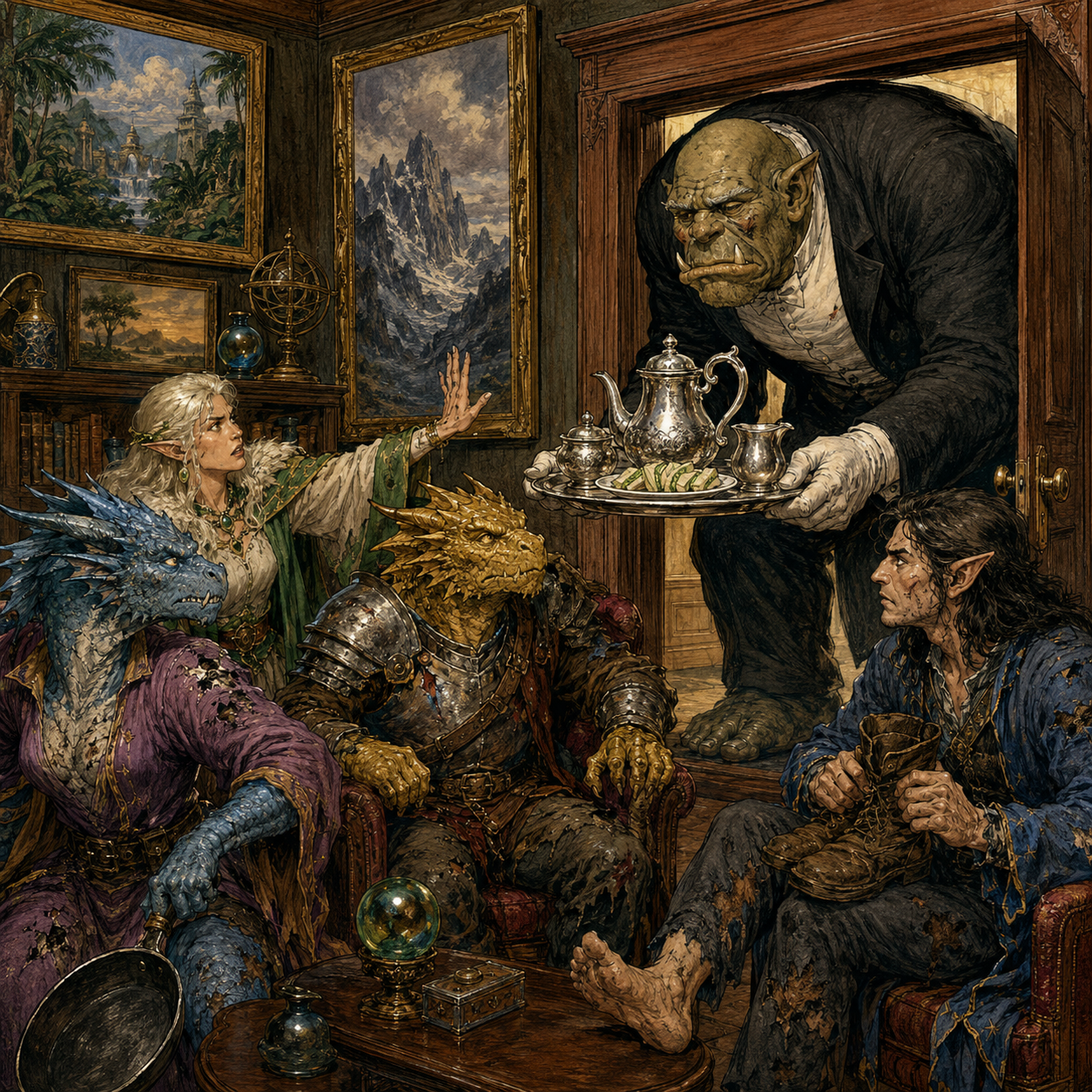
The sitting room had been designed to soothe anxious guests, which only made it more suspicious.
Soft couches stood around a polished table beneath the mellow glow of enchanted lamps. A brass-bound globe rested upon a pedestal in one corner, its painted seas gleaming darkly. Shelves and side tables displayed porcelain birds, silver animals, crystal flowers, and other costly ornaments chosen with such careful blandness that none seemed to have any purpose beyond reminding visitors that their host was wealthy, cultivated, and somewhere else. For the moment, the adventurers were alone.
They had crossed Veyr’s impossible hedge maze, survived its guardians, flown across perilous waters, chased gems that vanished from their hands, and deciphered a sundial whose shadow had pointed in every direction at once. At the maze’s heart they had found the tower, and at the tower’s door they had found an ogre who had taken their names, shut the door in their faces, and eventually admitted them. Now they waited.
Elora allowed her gaze to drift across the room, though little escaped the discipline behind her apparent idleness. The couches concealed no blades, the table no glyphs, the walls no hidden seams. Nothing suggested a trap ready to spring. Yet several of the ornaments troubled her.
A tiny ivory owl faced the couches at precisely the proper angle. A bronze flower had a dark, glassy center that caught no reflection. A silver beetle perched on a shelf with its wings half-open, though no craftsman would have chosen such an awkward pose without reason.
“They are watching us,” Elora said.
Thorn glanced toward the ivory owl. “Veyr?”
“Perhaps. Or his servants. The room is warded for observation.”
Maledurk leaned forward, bringing his broad brass-scaled face nearer to the bronze flower. “Can it hear us?”
“Probably.”
He cleared his throat and addressed the ornament. “We demand an audience.”
Tempest, slouched on the couch with the exhausted air of someone who had recently been struck by a furious dao, lifted one blue-scaled hand. “We already have an audience,” she said. “They are just very small and badly decorated.”
Nothing applauded.
The others exchanged looks. Their long journey had taught them to be wary of hospitality, particularly hospitality involving tea. Poison had worn many masks in their travels, and few were as convincing as porcelain cups, lace napkins, and a servant insisting that everything was perfectly safe. Still, there was little to do but wait.
The door opened before impatience won. The ogre returned carrying a silver tray that looked almost delicate in his enormous hands. Upon it sat a steaming teapot, five cups, and a plate piled with neatly cut cucumber sandwiches. He set the tray on the table with surprising care and poured for each of them.
“Master Veyr will be with you in a few moments,” he said. “Please enjoy yourselves.”
The scent of fresh bread, cucumber, herbs, and warm tea filled the room. Maledurk eyed the sandwiches with open longing. Thorn eyed them as if they might be disguised assassins. Elora looked at Tempest. Tempest looked at Elora.
“No,” Tempest said.
“You have not even been asked anything,” Thorn observed.
“You all have the same face.”
Maledurk nudged the plate toward her. “You are closest.”
“I am also the most injured.”
“That makes you the best judge of whether they restore health.”
Tempest sighed the long sigh of one unfairly burdened by the incompetence of friends. She picked up a sandwich, examined it, smelled it, and took a bite.
For a heartbeat, nothing happened. Then her eyes widened. She toppled sideways and struck the couch cushions.
The ogre froze. The color seemed to drain from his broad face. He rushed toward her, nearly overturning the tea table in his alarm. “What is wrong?” he cried. “What has happened?”
Tempest sat upright. “I got you.”
Silence settled upon the room. She took another bite.
The ogre stared at her, then at the others, then back at her, as though trying to decide whether this was a custom among smaller folk or evidence of sudden madness.
“These people always make me try everything first,” Tempest explained. “I thought they deserved it.”
“You are unharmed?”
“The sandwich is excellent.” She drank from her cup and nodded solemnly. “The tea is also very nice.”
Relief passed over the ogre’s face, followed by confusion, then the weary acceptance of a servant who had encountered something he would later choose not to mention. He bowed and departed.
The others fell upon the food. Whatever suspicions remained were no match for hunger. The cucumber sandwiches were crisp and cool, spread with soft cheese and fragrant herbs. The tea carried a subtle sweetness and warmth that seeped through bruised flesh and wearied minds.
They ate until the tension of the maze began to loosen its hold. Tempest’s wounds faded and Maledurk’s battered muscles eased. Thorn felt the tightness behind his eyes diminish, while Elora sensed the frayed edges of her magic knitting themselves whole. For a little while, they were merely travelers at rest.
When the ogre returned, they were full, refreshed, and in Maledurk’s case, attempting to determine how many remaining sandwiches could be carried in his pockets without being crushed.
“Master Veyr will see you now,” the ogre announced.
“What about these?” Maledurk asked, indicating the plate.
“You may take them.”
Maledurk swept the remaining sandwiches into his pockets. The ogre watched him do it.
“I could have brought you more.”
“This is quicker.”
The ogre introduced himself as Gerald while leading them from the sitting room. The corridor curved gently along the tower’s circumference. Paintings hung at measured intervals along the walls, each depicting some lonely expanse of the natural world. Deserts stretched beneath white suns, forests gathered under mist, hills rolled beneath clouded skies, frozen wastes shimmered in blues and grays. There were no people in any of them, no beasts, no roads or cottages or ruins or ships. Only the world, emptied of everyone who lived there.
The paintings were strangely indistinct when viewed closely. Trees became strokes of dark pigment. Mountains dissolved into angular washes. Waves were nothing more than overlapping bands of color. Yet from a distance each scene had an uncanny depth, as though the image were less a painting than the memory of a place.
Gerald led them upward through several flights of stairs and into a broad chamber dominated by floor-to-ceiling windows. Beyond the glass lay the hedge maze. From above, it was vast beyond reason.
Its green walls extended mile after mile, folding and refolding into an intricate geometry. Elora moved nearer to the windows and searched the horizon. The town they had passed should have been visible, the mountains rising in the distance, the road cutting through the surrounding country. There was nothing. The maze simply continued, spreading outward beneath an empty sky until haze swallowed it.
“This is not where the tower stood,” Elora murmured.
Thorn joined her at the glass. “The exterior may only be an entrance.”
“Or the tower moves.”
“Or the land outside is false.”
Maledurk peered over their shoulders. “It is a very large maze.”
Tempest stared at it for a moment, then turned away. “I already disliked it when it was smaller.”
A man waited at the far end of the chamber behind a large table. He was short for a human, perhaps five feet in height, and had embraced every traditional symbol of wizardry with either absolute sincerity or magnificent stubbornness. His robes fell in layered folds embroidered with stars and planetary circles. A pointed hat rose from his head at an angle that suggested it had opinions of its own. He looked up as they entered.
“You are late.”
Elora stopped. “We were waiting in your sitting room.”
“You were supposed to be here twenty minutes ago.”
“We were served cucumber sandwiches,” Maledurk said.
Veyr’s gaze shifted to Gerald. “Gerald?”
The ogre lowered his head. “They looked hungry, sir.”
“They were,” Tempest said.
Veyr sighed as though the entire discipline of timekeeping had suffered an insult. “Sit down. Time is very important here.”
They gathered around the table. A piece of paper lay before Veyr, covered by three enormous words written in a heavy hand:
THE GOOD GUYS.
Veyr lifted the page. “An unusual name.”
“It describes all of us,” Elora said.
“A bold claim,” Veyr replied. “And a boring one.”
Maledurk frowned. “You live in a tower surrounded by an endless hedge.”
“My work is fascinating.”
“What do you do?” Thorn asked.
Veyr’s expression sharpened with interest. “I study the cosmos. The planes. Dimensions. The relationships between realities and the means by which one may travel among them.”
At last, they had reached the reason for their journey. Elora told him what had happened to them.
She spoke of being drawn again and again into events that seemed separate, yet carried the faint marks of a single design. She told him of Chult, of the Soulmonger, and of the race that had somehow opened into Barovia, and how they had spent days in that grim realm only to return to the precise instant from which they had departed. She described Strixhaven, the life they had seemingly lived as students, and Magraxor. She recounted awakening in the Underdark and facing Demogorgon. She spoke of Jareth, the talking tree, and the strange task that had sent them gathering impossible objects from impossible places, and of Nimu and her hidden forest beneath the earth.
Veyr listened with the patience of a scholar and the sympathy of a stone wall. When Elora finished, he tapped one finger against the table.
“Reality is threatened by creatures, catastrophes, and fools every day,” he said. “You will need to be more specific.”
“We believe these events are connected,” Thorn said. “Someone has been moving us. Testing us, perhaps. Using us.”
“And you want to know who.”
“We want to know what is happening,” Elora replied. “And how to stop it.”
Veyr studied her for a moment. “You are a wizard.”
“I was trained as one.”
“One of those traveling wizards,” he said with faint disapproval. “You should settle down and find proper work.”
“This is my work.”
“Yes. Disturbing.”
He stood abruptly. “Come with me.”
Veyr strode from the chamber at a pace that forced the others to hurry. He led them through another curved hallway overlooking the impossible maze, then into an interior room lined with bookshelves and worktables.
Loose papers covered nearly every surface. Quills rested in ink-stained cups. Brass instruments with rotating rings stood beside crystals, lenses, astrolabes, and devices whose purpose even Thorn could not immediately guess. More paintings hung on the walls: a desert, a tundra, a plain, a forest, a sea beneath a pale horizon.
Veyr moved to one of the tables and began searching through a book. Elora approached the forest painting.
It was no larger than a theatrical poster. Its frame was dark wood, plain and unmarked. The image showed a dense forest beneath green light, but the details seemed unwilling to settle beneath her gaze. She leaned closer.
“What are you doing?” Thorn asked.
“I think these might be portals.”
Veyr continued turning pages. Elora stepped back. Then she ran forward and leaped into the painting.
She struck it with a crash. The frame tore free of its hook. Elora fell backward, the painting landing across her face and chest.
For one solemn heartbeat, no one spoke. Veyr looked up from his book.
“Are you all right?”
Elora pushed the painting aside and sat up. “It is not a portal.”
“No,” Veyr said. “It is not.”
Tempest helped her rise, though her expression suggested that this was the finest thing she had witnessed all day. Elora rehung the painting.
“They are more than they appear,” Veyr added. “They are intended for viewing and study, not for hurling oneself against.”
“What do they show?” Thorn asked.
Veyr closed the book. “They allow me to observe other planes. More specifically, they allow me to examine the relationships between planes and the ways in which dimensional boundaries overlap.”
“You made them?” Elora asked.
“Of course.”
“How far has your research progressed?”
“Considerably. In another three or four centuries, I may have something worth showing.”
Maledurk blinked.
Veyr crossed the room and stood before the forest painting. “You say you have traveled between dimensions, perhaps without understanding how or why. If dimensional residue remains upon you, these paintings may allow us to determine where you have been.” He looked at Elora. “Place your hand upon the center.”
Elora did so. The painted forest felt cool beneath her palm.
“Think of the glen where you met the talking tree,” Veyr instructed. “Describe it to yourself. Fix it in your thoughts.”
Elora closed her eyes. She remembered the hush beneath the branches. She remembered Jareth’s presence, ancient and rooted, and the strange pressure upon the bag that had held the crown. She remembered the wards that prevented passage by teleportation and the feeling that the glen itself had resisted what they carried.
The surface beneath her hand trembled. A murmur came from behind her. Elora opened her eyes.
The forest had changed. The vague woodland scene had become familiar. The curve of the trees, the green light, the open space between the roots, all of it carried the unmistakable shape of Jareth’s glen.
Then the laboratory vanished. Elora stood beneath the forest canopy. Leaves stirred overhead. Soft light filtered through the branches. Jareth stood where Elora remembered her, silent and immense.
“Elora?” Thorn’s voice sounded distant, muffled by an impossible gulf. She turned, but the others were gone.
“Jareth,” Elora called. “Can you hear me?”
The ancient being did not respond. Elora moved nearer. Nothing in the glen acknowledged her presence. She could see the place, but she had no weight within it. No breath stirred the air. No footstep bent the grass. She was an observer inside a memory of distance.
Elora pulled her hand away. The glen collapsed like a reflection disturbed by rain. The laboratory returned around her. Her companions stood exactly where they had been, watching the painting.
Veyr was already writing. “What did you see?”
“Jareth’s glen. I called to her, but she could not hear me.”
“Would she normally respond?”
“Yes.”
“Important to establish,” Veyr said. “Some beings simply dislike conversation. It corrupts the data.”
He examined the altered painting. “This suggests the glen lies upon the Material Plane, but is protected by significant magical barriers. Those protections interfered with the observation.”
“Interfered?” Tempest asked. “We saw it clearly.”
Veyr drew himself up. “I am very talented.”
One by one, they used the paintings. They called to mind the places through which they had traveled, and the images shifted to answer them. Veyr questioned them relentlessly, noted every detail, and compared their experiences against whatever hidden measures his instruments revealed. Gradually, their journey separated into categories.
Chult had been real and firmly rooted in the Material Plane. Port Nyanzaru, the jungle, the Soulmonger, all had occurred in the world they knew. The Underdark had also been real. Demogorgon’s presence there, however, disturbed even Veyr. Demons did not simply cross into the Material Plane without cause. Someone had brought the creature there, deliberately or through catastrophic folly. Had the adventurers not destroyed it, the consequences would have spread far beyond them.
Barovia was another plane, and so was Strixhaven. The strange regions surrounding the lost works of Qualish had been a web of pocket dimensions. The drowned town beneath poisonous slime, the isolated bubbles reached by submarine, the glacier, the black salt waste, and Knogbrüth’s tomb had all existed outside ordinary reality. Nimu’s underground forest was another dimension as well.
At that, Veyr paused. His expression tightened with the particular pleasure of a scholar meeting a fact that refused to fit.
“You have crossed dimensional boundaries far more frequently than you realized,” he said.
Thorn regarded the paintings. “How can we know which places were real?”
“By what remains when you leave.”
Veyr explained that some dimensions were complete realities, whether naturally formed or shaped by immense power. Objects taken from such places could endure beyond their boundaries. The Sunsword had come out of Barovia. The crown had come out of Knogbrüth’s tomb. The black salt gathered during their search for Nimu had remained with them. Those objects proved that the places they came from had true substance.
The chambers within Veyr’s hedge maze were different. The gems they had found there vanished when carried beyond the rooms because those spaces had been constructs, temporary imitations of reality made for a limited purpose.
“I designed them that way so no one would steal the gems,” Veyr said.
“Then those dimensions were less real?” Maledurk asked.
“False, in a sense. Artificial. An amateur creates a place from which nothing can be removed.”
Veyr stopped. He frowned at the realization that he had just classified his own work as amateurish.
“I did it deliberately,” he added.
“Of course,” Thorn said.
Veyr’s explanation did little to reduce the strangeness of what they had experienced. If anything, it deepened it. Their lives had become a path crossing realities, dreams that were not dreams, memories that could hold swords, and worlds that existed only until one stepped through a door.
Yet one fact sharpened through the confusion: their movements had not been random. Someone, or something, had repeatedly placed them at the seams between worlds. Veyr seemed increasingly convinced of this, though the possible destruction of existence concerned him less than the elegance of the mystery.
“Dimensional travel is not merely movement through space,” he said. “Time is itself a dimension. To travel between realities is often to travel through time, whether one intends to or not.”
He pointed to their experience in Barovia. They had departed during a race, lived through days and dangers beneath Strahd’s shadow, and returned at the same instant they had vanished. To those watching in Chult, no time had passed. To the adventurers, a piece of their lives had unfolded.
“That was time travel,” Veyr said. “Not a metaphor. You traveled through time as surely as you traveled through space.”
Thorn had long suspected that the pattern surrounding them reached beyond any ordinary enemy. Elora had felt it in the way each new path opened beneath their feet before the last had fully closed. Tempest’s chaos had often made the world appear mutable, but this was something greater than wild magic. Maledurk, who preferred enemies that could be struck, found little comfort in the idea that their adversary might move through histories as easily as through doors.
“We need to know where this began,” Elora said.
“Yes,” Veyr replied. “If we can separate the mundane events from the truly unusual ones, we may identify a pattern. Connections between the places. Connections between the times. Perhaps even some indication of where you are meant to go next.”
“Can you sense a threat to the balance of the planes?” Thorn asked.
“Such threats exist.”
“Is one happening now?”
“Possibly. Sometimes such disturbances are caused by beings intent on conquest, destruction, enslavement, or similar dull ambitions. A substantial number are caused by wizards attempting something clever and failing.”
His gaze passed briefly over Thorn and Elora. “There are many fools among us.”
The testing continued until Veyr’s attention returned again and again to Nimu. The hidden forest did not fit neatly with the others. Its boundary had been subtle. The adventurers had crossed without the violent wrench of planar travel. It was concealed, almost secret.
Then there was the crown. They had kept it sealed inside a lead box, hidden within a portable hole carried in Elora’s pack. Both Maledurk and Thorn had worn it. Each had fallen into a state of near catatonia while experiencing vivid visions.
Nimu’s reaction had been different. When she placed the crown upon her head, she had remained standing. Her voice had changed. Her posture had changed. She had looked around the hidden forest as if seeing it through another’s eyes and said, “She would be here.” Then she had leaped through the window.
Once the crown was removed, Nimu had returned to herself. She remembered the compulsion to put it on. She remembered her own identity being pressed downward, forced away from the surface of her mind while another presence took control.
Veyr listened with complete attention. “I would like to examine it,” he said.
The room became still. Maledurk’s hand moved nearer to his weapon. Thorn watched the wizard’s face. Tempest studied the tables, perhaps calculating how many could be overturned if something went wrong.
Elora met Veyr’s gaze. “Can you do so safely?”
“As safely as anything involving an unknown interdimensional artifact containing a potentially hostile intelligence.”
“That is not very reassuring.”
“It is honest.”
Elora considered what she had seen of him. Veyr was vain, reclusive, dismissive, and wholly captivated by his own brilliance. He did not seem concerned whether the adventurers survived their struggle. He might not have cared whether the world survived it. But he cared about understanding the crown. His curiosity was genuine, and for the moment, their interests aligned.
“All right,” Elora said. “But it remains in our presence.”
“Acceptable.”
Veyr took a wand from one of the worktables. He stared at a blank wall, silently calculating, then traced a figure through the air. A door appeared. He opened it.
Beyond lay a vast gray chamber. The walls, ceiling, and floor were all the same dull color, which made distance difficult to judge. In the center stood a solitary stone plinth. Across the room was a low fortified shelter with a narrow viewing slit.
Veyr gestured toward it. “I liked your suggestion about observing from behind a barrier.”
Maledurk nodded. “It was a good suggestion.”
They entered. The door vanished when Veyr closed it.
Elora retrieved the portable hole, drew out the lead box, and handed it to him. Veyr carried it to the plinth and set it down. Then he joined the others in the shelter.
From thirty feet away, he conjured a spectral hand. The translucent fingers opened the box. Nothing happened. The crown lay within, dark and still. The spectral hand lifted it from the lead lining and placed it atop the box. Again, nothing happened.
They waited. The crown did not glow or whisper. No spectral figure emerged, no crack opened in reality. It sat beneath the flat gray light, looking almost ordinary.
“Does it generally do anything on its own?” Veyr asked.
“Not unless someone wears it,” Elora said.
“No juggling?” Tempest added.
“No juggling,” Maledurk confirmed.
Veyr watched it a little longer, then left the shelter. He approached the plinth cautiously, circling it several times. He cast spells toward the crown, studying the way each enchantment touched or failed to touch it. Some seemed to slide away. Others produced reactions too slight for anyone but Veyr to notice. He wrote notes after every attempt.
At last he extended his quill and poked the crown. Then he jumped backward. Nothing happened. He poked it again, held the feathered end against the metal, and waited. Still nothing.
Veyr returned to the shelter. “Direct contact appears necessary. More specifically, contact with living flesh. It resists several forms of magical examination, but I believe the object contains memories.”
“Whose?” Thorn asked.
“That,” Veyr said, “is the useful question.”
Maledurk remembered the visions that had seized him while wearing the crown. They had felt real. He had moved through them, acted within them, made choices. Or believed he had.
Veyr proposed a darker possibility. Perhaps the crown did not merely show memories. Perhaps it compelled the wearer to reenact them. The wearer might feel free, might believe each decision belonged to them, while in truth following a path already laid down by someone else.
“How much freedom does a person possess inside a memory?” Veyr asked. “You may think you are choosing. But perhaps you are only remembering someone else’s choice.”
No one answered. Even Tempest had grown quiet.
Veyr admitted that he had no intention of placing the crown upon his own head. For a fleeting moment he considered Gerald, then seemed to decide that sacrificing one’s ogre servant to scholarship might create domestic difficulties.
Elora suggested using a magical intermediary, something through whose senses they could observe without exposing a mind directly. The idea interested Veyr, though it did not resolve the central mystery. Nimu had not merely watched. Something had used her.
“Perhaps the crown was looking for her,” Veyr said.
If that was true, Nimu’s hidden forest might not have been a refuge chosen at random. She could have been hiding from the power within the crown, knowingly or otherwise. Or she might have been waiting in concealment until the crown found its way back to her.
“You brought it to her,” Veyr said.
Elora felt the weight of that truth. Nimu had seemed kind. Helpful. Odd, certainly, but no more than many beings they had met. She had fed them and guided them. Nothing in her manner had suggested that she was waiting to become a vessel for another will. Yet appearances had deceived them before.
“Do you think she is responsible for what is happening?” Thorn asked.
“If forced to guess, no,” Veyr replied. “But she may be connected to it in ways she does not understand.”
“Then we should return to her,” Elora said.
Veyr’s interest brightened. “I would prefer she come here.”
“You want us to bring Nimu through your maze?”
“Yes.”
“Can you not make the passage easier?”
“What good are defenses if one weakens them whenever guests complain?”
“You know us now.”
“I know you survived once. You also know the correct path. Simply avoid doing anything stupid.”
Maledurk began trying to remember the sequence of sundials. Thorn disagreed with his second turn. Tempest proposed walking through every hedge until one worked. Elora wondered whether Veyr’s maze might prove more dangerous the second time simply out of spite.
Their debate was interrupted by a voice inside Elora’s mind. “Excuse me. Is this Elora the Majestic?”
Elora stiffened. “Yes.”
The distant speaker sounded relieved. “Good. I reached three wrong people before you.”
The message came from Waterdeep, from those continuing the research Elora had begun before the party’s departure. They had uncovered information concerning Knogbrüth. Or rather, two pieces of information, both from sources considered reliable, both describing the same period of history.
In one account, Knogbrüth had been a terrible wizard who raised an army of the dead in the frozen north. His reign of terror had ended when Svensson the Bold defeated and slew him. In another account, Knogbrüth had been a human king ruling lands far to the east. The dates overlapped, and the distances were too great. By every ordinary measure, Knogbrüth could not have been both men.
Elora repeated the message aloud. The chamber seemed to contract around the words. A wizard in the north, a king in the east, two histories unfolding at the same time.
Veyr’s earlier lesson returned with sudden force. Dimensional travel was also travel through time. A traveler might leave one moment, spend years elsewhere, and return before the next heartbeat. A being who understood such movement might deliberately inhabit histories that contradicted one another.
Thorn’s eyes narrowed. Maledurk looked toward the crown on its distant plinth. Tempest, for once, did not offer a joke.
Knogbrüth’s tomb had existed in another dimension. His crown carried memories and a will capable of suppressing the mind of its wearer. Nimu had been hidden in yet another dimension and had reacted to the artifact as no one else had. Now history itself claimed Knogbrüth had lived two lives at once.
There was no alarm in Veyr’s expression, only fascination. “At last,” he said softly, “something interesting.”
Beyond the shelter, the crown waited in silence. It had survived the death of a necromancer, the end of a king, the crossing of dimensions, and the passage of centuries. Perhaps the histories were false. Perhaps one Knogbrüth had become two, a single mind moving between lives as easily as the adventurers had been moved between worlds.
Whatever the truth, a pattern was beginning to emerge. Their journeys had done more than carry them across distant lands; they had been threaded through realities, and each passage had left residue on their bodies and memories. Barovia, Strixhaven, the Underdark, Knogbrüth’s tomb, the hidden forest: all points on a design they could not yet see in full. At its center stood a crown filled with another life, and somewhere beyond it waited Nimu.
Across the divided pages of history, Knogbrüth had begun to exist twice.
The session opened with a recap of the party’s progress through Veyr’s magically defended hedge maze. The party waited alone in the tower’s sitting room. Thorn examined the room and made a Perception check, receiving a result of 25. The party debated how to respond to being watched and whether they should continue waiting. Before the party decided whether to leave, the ogre returned with the promised refreshments. The party remained wary of the food because of their previous experience with poisoned tea. Once Tempest demonstrated that the refreshments were safe, the rest of the party began eating. After some time, the ogre returned and announced that Veyr was ready to see them. The ogre led the party through the interior of the tower. The ogre led the party up several flights of stairs and into a large upper room. Veyr looked up as the party entered and immediately told them that they were late. Veyr had the page on which Gerald had recorded the party’s name. The party attempted to begin explaining why they had come. The party explained that they needed information about a possible threat to the greater realm. Veyr recognized Thorn as another practitioner of magic. The party gave Veyr an extensive account of their adventures. Veyr said that reality was constantly threatened by creatures and catastrophes, but he found the party’s situation unusual. Veyr led the party through another hallway with windows overlooking the hedge maze. Veyr brought the party into an interior laboratory or research chamber. Elora suspected that the paintings might be portals. Veyr questioned Elora about what she had been trying to accomplish. Veyr reviewed the party’s history to confirm that he had understood it correctly. Veyr explained the true purpose of the paintings. Veyr explained why he had brought the party to the laboratory. Veyr instructed Elora to use the forest painting properly. The forest painting transformed in response to Elora’s thoughts. Veyr questioned Elora about what she had experienced. The party experimented further with Veyr’s paintings. Veyr concluded that the party’s experiences in Chult were genuine events on the Material Plane. Veyr determined that Barovia was a separate dimension or plane of existence. Veyr explained that time itself should be understood as a dimension. Veyr determined that the party’s apparent life at Strixhaven had also occurred in a different plane or dimension. Veyr concluded that the Underdark was part of the Material Plane. Veyr examined the party’s experiences connected with the Lost Laboratory of Kwalish and determined that several of those locations had been separate pocket dimensions. The party asked how they could distinguish a real dimension from a false or constructed one. Veyr contrasted the maze gems with objects the party had carried out of other dimensions. The party asked how Veyr’s findings would help them identify or stop the force behind their adventures. The party asked whether Veyr had detected a larger disturbance in the balance of reality. As Veyr reviewed his observations, he became especially interested in Nemu’s underground forest. Veyr asked the party about the crown. Veyr focused on the different reactions produced when the crown had been worn. The party clarified what Nemu remembered about the incident. Veyr said Nemu’s reaction suggested that the crown’s effect might be personal rather than based on her species or magical abilities. Veyr asked whether the party would permit him to examine the crown. Elora made an Insight check to judge Veyr’s intentions and rolled a natural 20. The party agreed to let Veyr examine the crown under controlled conditions. Veyr and the party entered the magically created space. The lead box containing the crown was placed on the central plinth. Veyr used Mage Hand to open the lead box remotely. Veyr reconsidered the resistance the party had felt while carrying the crown into Jareth’s glen. After observing the crown from the bunker, Veyr decided the precautions might have been excessive. Veyr eventually tested the crown with a quill. Veyr determined that the crown was filled with memories. The party considered other possible ways to test the crown. Veyr returned to the question of why Nemu’s experience differed from the others. The party proposed returning to Nemu’s forest and asked whether Veyr would accompany them. While the party debated its next step, Elora received a magical message from the researchers in Waterdeep. The Waterdeep researchers had found two conflicting histories concerning Knogbrüth. The party recognized that the contradictory histories fit Veyr’s explanation of dimensional and temporal travel. The session ended with the party having gained a broader understanding of its situation.Session Notes