For three days, the crown sat at the center of Veyr’s tower like a captured star that no one dared touch.
It rested within its lead-lined box whenever it was not under examination, dark metal hiding darker mysteries, while Veyr circled it with all the reverence and suspicion of a scholar studying a sleeping dragon. The revelations already surrounding the artifact had left the companions with more questions than answers. Two histories existed for Knogbrüth, both apparently true. In one, he had been a powerful and beloved king. In another, he had become a lich whose armies had drowned kingdoms beneath the dead. The crown contained memories of both lives. And Nimue, unlike Thorn and Maledurk, had not merely collapsed beneath its influence. She had risen, changed, and tried to flee with it.
Veyr had asked to keep the crown for several days, and no one had been particularly eager to leave him alone with it. Not because he had given them cause for distrust; quite the opposite. His fascination was unmistakably academic. The possibility that reality itself might be unraveling seemed to concern him rather less than the fact that he had been handed a puzzle no one else had solved.
Still, the Nefarious Do-Gooders had accumulated certain rules during their travels, most of them written in scars, and one of those rules was that powerful magical artifacts with a habit of possessing people should not be left unattended.
So they stayed.
At first, watching Veyr work was interesting. Then it became educational. Then it became almost aggressively boring.
Invisible servants lifted the crown from its case so Veyr could inspect it without allowing his own flesh to touch it. He surrounded it with circles of chalk and powdered minerals, whispered spells over it, stared through lenses of crystal and smoked glass, and filled page after page with cramped notes. On another day he concocted tinctures and alchemical solutions, applying careful droplets to the crown and observing each reaction. Sometimes he would suddenly straighten.
“Hm.”
Then his hands would fly across a page.
“Hmmm.”
A dozen frantic notes would follow, and then his shoulders would slump.
“Huh.”
Whatever promising avenue he had discovered would apparently have collapsed beneath the weight of another contradiction.
By the second day, watching Veyr had begun to resemble watching paint dry. Veyr cheerfully observed that there was, in fact, a wall in the tower that could use painting. He was less enthusiastic about painting it himself.
By the third day the companions had divided their attention between keeping watch on the crown and enjoying the considerably more interesting comforts of the tower. Gerald’s cooking was excellent, the rooms were comfortable, and the promised luxuries of Veyr’s retreat were difficult to resent. Even adventurers attempting to prevent a planar catastrophe could appreciate a decent meal.
Then, finally, Veyr summoned them. The crown was back in its box, his notebooks were stacked around him in precarious towers, and the expression on his face had changed.
“I think,” he said, “I have found something useful.”
That was enough to gather everyone’s full attention.
Veyr began with Knogbrüth. The conflicting histories found in Waterdeep were not errors. Both had happened. He had been able to draw only fragments from the crown, fleeting impressions embedded within the impossible tangle of memories it carried, but those fragments revealed two distinct paths. In both, Knogbrüth acquired the crown, though how he had obtained it remained hidden. Then came a choice.
In one history, Knogbrüth embraced the crown’s power completely. He continued using it, surrendering himself to its possibilities. That path ended with undeath. Lichdom. An army of corpses. Conquest. War. It was the history Thorn had witnessed when the crown first seized him.
In the other history, Knogbrüth wore the crown only briefly. Then, for reasons Veyr could not determine, he stopped. That Knogbrüth became a great king. Powerful, certainly, but beloved. That was the world Maledurk had glimpsed.
One man, one artifact, one choice. Two realities.
Veyr believed the decision had split something fundamental. Reality itself had forked around Knogbrüth. The thought settled uneasily over the room.
The crown, Veyr continued, was not sentient. At least, he had found no evidence of thought in the way living minds understood it. But neither was it inert. It had purpose, a drive, a direction. The closest comparison Veyr could offer was an automaton built to perform a task. It did not need to understand its work. It simply continued until that work was finished. The crown was trying to accomplish something.
More unsettling still, Veyr suspected it was trying to reach someone. Or something. He had found no accessible memories from before Knogbrüth possessed it, but the crown felt incomplete to him. Not damaged exactly, but divided. Perhaps part of a soul had been sealed inside it, or some fragment of a being’s essence. Whatever the truth, the crown behaved as though another part of itself existed somewhere beyond it.
And it wanted to become whole.
Nimue immediately became the most troubling possibility. When Thorn and Maledurk had worn the crown, they had fallen unconscious and been drawn into visions. When Nimue had worn it, her consciousness had been shoved aside. Something else had stood up inside her body. Something that had run.
What if Nimue was the crown’s missing half?
The room seemed to grow colder despite the warmth of the tower.
Veyr cautioned them against assuming Nimue knew any more than they did. If she truly was only a fragment of some older being, she might have no memory of that existence. She might sincerely believe herself to be nothing more than Nimue. Perhaps even the knowledge of reunification lay divided between the two halves: the crown might contain part of some ritual, Nimue the rest, and neither would understand until they were brought together.
The companions exchanged grim looks. Returning to Nimue suddenly seemed both obvious and extraordinarily dangerous.
Elora voiced the concern hanging over them all. If Nimue and the crown were reunited, what would emerge? An ally? An enemy? Something capable of ending kingdoms? They had spent enough time surviving impossible threats to know that ignorance was rarely protection. If they were going to confront whatever lay behind the crown, perhaps they should prepare first. Training. Allies. Research. An army, if necessary.
Someone suggested that perhaps what they truly needed was a course in defending themselves against dark magic. Another suggested monks. More monks, apparently, remained a viable strategy for nearly every conceivable disaster; no one could immediately name a problem that had been definitively proven immune to the application of additional monks.
Veyr listened with patient amusement, then returned them to the stranger possibility. He did not think their history of accidental planar travel could be coincidence. Their lives had been marked by impossible displacements: the mountains and the search for Kwalish and Daoine Gloine, Barovia and Strahd, Strixhaven, the Underdark and a demon lord that should never have been there, Nimue hidden away beyond the ordinary world. Again and again, the companions had been pulled into places where they had not intended to go. People who traveled between realities that frequently were usually scholars like Veyr. And scholars like Veyr did it deliberately.
Then, after all those journeys, the companions had found the crown. Not just any crown, but an artifact apparently capable of bending reality around itself. Veyr did not believe that was chance. Perhaps the crown had been influencing them long before they ever laid eyes upon it.
That possibility made even their earliest adventures feel suddenly suspect. Were they being hunted? Guided? Tested? Had the crown somehow arranged the road beneath their feet? Veyr could not say. But he suggested that their old journeys might contain answers they had not known enough to recognize the first time. Strixhaven might hold clues regarding the lives they had briefly touched there. Barovia might yet conceal some residue of what had drawn them into Strahd’s realm. Their adventures in Chult, beneath Omu, or in the Underdark might contain another piece. Even Kwalish might know something now that they understood what questions to ask.
It was a profoundly uncomfortable suggestion. Their past had always seemed chaotic, and now someone was suggesting it might have been deliberate. Tempest found that possibility almost offensive in its audacity. Chaos was one thing. Being manipulated by something pretending to be chaos was another entirely.
Maledurk scratched at the problem more directly. If the crown wanted something, could they simply ask it? Was it evil? Good? Did it merely wish to be whole?
Veyr shook his head. The crown did not appear capable of answering, and even its history refused to provide a simple moral judgment. Knogbrüth had used it to become a monster in one reality and a beloved ruler in another. The artifact might be neither benevolent nor malevolent. It might simply be power. Power, and purpose. What mattered was the hand that wielded it, or the being it became when completed.
Before deciding where to travel next, they sent new information to the researchers in Waterdeep. The scholars there already knew of the contradictory histories surrounding Knogbrüth. Now they were given the connection to Nimue, Veyr’s theories regarding the crown, and the possibility that all the companions’ strange journeys formed a larger pattern. They were asked not merely to research one name or one place, but to look at everything, find the connections, and find the shape hidden beneath the scattered pieces. The answer would take time. And time, as Veyr had just explained, might not mean what they thought it did.
That realization brought the conversation back to the crown itself. There was one source of information no scholar could entirely replace: the artifact. Veyr had studied it from every safe distance he could contrive. Perhaps the next experiment required someone to wear it.
Thorn volunteered.
The decision produced an immediate change in Veyr. For three days he had been a careful scholar. Now he became a delighted one. The chamber was transformed. Instruments appeared from cabinets. Crystals were positioned. Arcane diagrams were drawn across the floor. Devices whose purpose Thorn could not begin to guess were arranged around a chair and the lead-lined box.
Elora remained close. She had freed Thorn and Maledurk from the crown before, and if it seized him again, she was prepared to tear its influence away with restorative magic. Veyr would observe everything.
Thorn looked at the box. He had seen what waited inside the crown once already: an army of the dead, a war, a feeling of triumph that had not belonged to him. Knowing that did not make opening the box easier.
The crown lay inside. Thorn reached down and took it.
The change began immediately. The metal seemed almost warm in his hands, and familiar. Not familiar in the way of an object remembered, but in the deep, treacherous way of seeing someone beloved after years apart. His caution blurred. The crown belonged on his head. The thought was absurd. It was also utterly convincing. A smile touched Thorn’s face. Then he raised the crown and placed it upon his brow.
The tower vanished. His body struck the floor.
And Thorn stood beneath a sky filled with war. Only he was not standing. He had no feet, no hands, no body. He simply was.
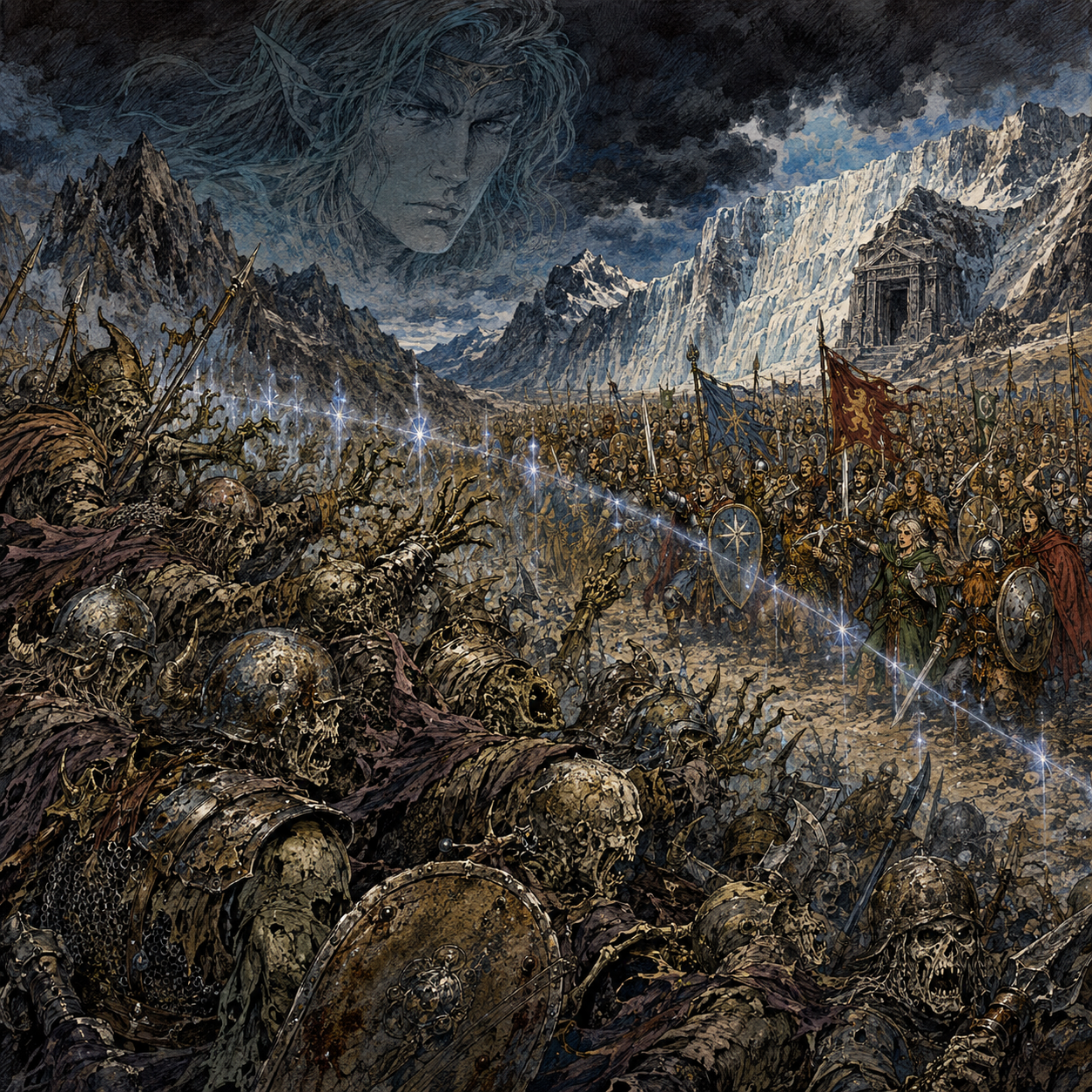
Below him stretched a valley beside the glacier where they had once found Knogbrüth’s tomb, and armies filled it. On one side stood the living. Humans, elves, dwarves, and others formed ranks beneath battered standards, their lines bending beneath the relentless assault. Opposite them came the dead. Thousands, perhaps more, moving with the terrible persistence of things that did not fear pain, exhaustion, or death.
And Thorn watched from their side.
Worse, some part of him exulted in it. The living were breaking. The dead were winning. Triumph surged through him, and pride, and power, and the intoxicating certainty that the battlefield belonged to him. For several terrible moments, there was no Thorn. There was only the one who watched the living die and rejoiced.
Then a thought surfaced. A name. His name.
Thorn.
He clung to it, and memory followed. Veyr’s tower. The experiment. Elora waiting beside his body. Maledurk. Tempest. The crown. The identity pressing itself over him did not vanish, but Thorn forced space between himself and it. He remembered that he had chosen to come here. And if he could remember that, perhaps he could do more than watch.
He reached outward with magic. Across whatever impossible distance separated his mind from his body, Thorn sent a message, and Maledurk heard his voice. I’m in. The battle. The undead. The same place.
Back in the tower, Maledurk relayed the words. Veyr stared at Thorn’s motionless body with growing fascination. The crown was communicating with him, that much Veyr could detect. But Thorn’s message proved something far more important: he remained himself. Not entirely, and not safely, but enough to act.
Veyr’s earlier assumptions began shifting. Perhaps Thorn was not experiencing a memory at all. Perhaps his consciousness had been projected somewhere else. The condition of his abandoned body resembled descriptions of astral projection, the flesh remaining behind, empty of its driver, while the awareness traveled elsewhere. If so, the crown might not merely remember. It might connect.
Inside the vision, Thorn tested that possibility. He thought of movement, and moved. The battlefield slid beneath him. He soared without wind, weight, or wings. When he tried to look at his own hand, there was nothing to see. No ghostly outline. No spectral fingers. He was a viewpoint, a consciousness without a body, a watcher floating over history.
He studied the armies more closely. The living force was losing. One flank had begun to collapse under pressure from the undead, and if it broke entirely, the dead would pour through the gap and sweep around the main army. Thorn wondered if he could interfere.
Then he had another thought. Why do this alone? He contacted Maledurk again. Come with me.
Maledurk, never one to allow impossibility to remain untested merely because it was ridiculous, attempted exactly that. Thorn lay unconscious with the crown seated upon his head. Maledurk lowered himself beside him and attempted to fit his own head into the crown from the opposite direction. The spikes were inconvenient. The arrangement was undignified. Nothing happened.
Apparently the crown had very specific opinions about which side counted as “wearing.” Maledurk withdrew.
Inside the battlefield, Thorn decided to try something more ambitious. Magic had crossed the boundary once. Could more? He focused on the collapsing flank and pictured a wall. Not stone, not something that needed foundations, builders, or time. Pure force, invisible and absolute. Thorn reached for the spell. For an instant he felt resistance, not from the crown exactly, but from the alien reality around him. He concentrated harder.
The spell answered.
Below, the undead charged. The first rank struck nothing. Bodies slammed backward, and those behind crashed into them. A line of dead warriors clawed, hammered, and pushed against empty air. They could not pass. The living soldiers facing them stumbled backward, staring in confusion. Their enemy had simply stopped. No visible barricade stood between them, no ditch, no shield wall, yet the dead could not advance.
The living hesitated only briefly. Runners sprinted toward the main force, reinforcements came, and the broken flank began to reform.
Thorn watched in astonishment. He had done it. This was not merely a vision. Or if it was a vision, it was one capable of being wounded.
The undead eventually discovered the limits of the barrier and began moving around it, but the delay had been enough. The living army concentrated around the opening. Soldiers rallied, formations reassembled, and then they counterattacked. The dead were pushed back. A battle that moments before had seemed destined for slaughter began to turn.
And something inside Thorn became furious.
The rage came without warning, immense and personal. This was wrong. His army had been winning. His victory had been stolen. The emotion struck with such force that Thorn nearly lost himself beneath it. His army. His victory. The words were not his, yet the anger was inside him. He felt the crown recognize, somehow, that what he had done opposed the memory it had shown him. Or perhaps opposed the will embedded within it.
In the tower, everyone saw the crown move. No hand touched it. No spell struck it. It simply slipped from Thorn’s head and fell away.
The battlefield vanished. Darkness swallowed him. Then Thorn opened his eyes on the floor of Veyr’s tower.
For a moment he simply breathed. Around him stood his friends. Nearby lay the crown. It had removed itself, and that fact troubled them almost as much as everything Thorn had seen.
He told them what had happened. He had been watching from the perspective of the undead force, perhaps from Knogbrüth’s own viewpoint. At first, the triumph of their victory had felt like his own. But Thorn had maintained enough control to act against that perspective. He had helped the living. And when they began to win, the rage had come. Then the crown had thrown him out.
Elora considered the implication. If the crown truly had no mind, what had rejected Thorn? Had it been some preserved fragment of Knogbrüth? The crown’s missing owner? The force it sought to reunite with? Or merely the artifact’s purpose reacting mechanically when Thorn interfered with the outcome it was trying to preserve?
Maledurk’s earlier experience stood in stark contrast. When he had worn the crown, he had seen Knogbrüth as a king before cheering subjects. Thorn saw the lich. Two histories, two perspectives, two possibilities. Perhaps, they wondered, each wearer was being shown something different for a reason. Perhaps the crown was testing them, or selecting them, or simply using whatever paths through reality were available.
They returned again to the question of good and evil. The crown had not tortured Thorn. It had shown him. It had allowed him to move and to cast magic, and it had ejected him only after he acted against the victory of the undead. That hardly absolved it, but neither did it reveal a simple villain. The crown remained what it had always been.
A question made of metal.
Then Elora stiffened. A voice had entered her mind: the researchers in Waterdeep. Their message began with confusion. They had been studying Knogbrüth’s history exactly as requested, but something was wrong. Yesterday, the history of the lich had been long and terrible. The records had described kingdoms falling before him, a vast campaign, an undead army rolling across the land until, after great devastation, Knogbrüth was finally defeated.
That history no longer existed.
Now the records told a different story. A lich had risen in the valley. An army of the living had stopped him before he could escape it. The uprising had been crushed almost immediately. A historical catastrophe had become a footnote. The researchers could find no record of the conquests they themselves had read only the day before.
Silence took the tower. Every eye slowly turned toward Thorn. Toward the crown. Toward the invisible wall he had placed upon a battlefield that should have existed only as memory.
Thorn had not watched history. He had changed it.
Somewhere in the past, an army had reached a flank that should have collapsed and found an impossible barrier waiting for them. Soldiers who should have died had rallied. A battle that should have been lost had turned. Kingdoms that should have fallen had survived. And the world had quietly rewritten itself around that single act. Only the companions remembered that it had ever been otherwise.
The crown sat motionless upon the floor. Silent. Unthinking, according to Veyr. Driven by nothing more than purpose. Yet suddenly the question was no longer whether it could alter reality. The evidence surrounded them. The question was how many times it already had.
And whether the lives they remembered were the first version of their own.
The session began with the party still at Veyr’s extradimensional tower, following their previous conversation with him about the mysterious crown and the unusual pattern of planar and dimensional events surrounding the group. Veyr asked the party for permission to continue studying the crown. Veyr spent approximately three days examining the crown. At the end of the three-day investigation, Veyr summoned the party and announced that he believed he had uncovered useful information. Veyr concluded that Knogbrüth’s decision involving the crown had somehow caused reality itself to split. When the party asked who the crown belonged to, Veyr said that was one of the most important unanswered questions. The party questioned how an apparently non-sentient crown could actively attempt to accomplish anything. Veyr connected this theory directly to the party’s long history of involuntary planar and extraplanar adventures. When asked what the party should do next, Veyr identified Nimue’s reaction to the crown as his greatest remaining question. The party expressed concern about confronting Nimue without being prepared for the possibility that she and the crown could combine into something enormously powerful. Veyr agreed that caution was reasonable because he had no way to predict what Nimue would become if she fully reunited with the crown. Veyr also suggested that returning to previous locations from the party’s adventures might reveal additional pieces of the mystery. The party invited Veyr to accompany them. The party discussed whether Nimue represented the fastest path toward useful information. The party reviewed their transportation options. Veyr pointed out another detail that strongly supported his theory that the crown had manipulated events. The party asked whether they could somehow communicate directly with the crown and determine whether its goal was benevolent or malevolent. The party considered both possibilities. Veyr noted that the histories discovered by the Waterdeep researchers supported the idea that the crown itself might not have a fixed moral alignment. Veyr also noted that Knogbrüth must have possessed substantial knowledge about the crown. The party proposed conducting a more controlled experiment with the crown while Veyr was present. Veyr explained that there were forms of magic capable of viewing another person’s thoughts or mind. Thorn volunteered to wear the crown again. Thorn picked up the crown and made a Wisdom saving throw, receiving a result of 16. Thorn again found himself witnessing the battle he had seen during his previous experience with the crown. Thorn attempted to maintain awareness that he was still himself and that the experience was an experiment. Maledurk received Thorn’s message and relayed the information to the others. Veyr reconsidered his previous assumption that the crown was merely replaying stored memories. Within the experience, Thorn examined his surroundings more carefully. Thorn examined the two armies. Thorn asked Maledurk through Sending whether Maledurk could somehow join him. The group recalled Maledurk’s previous vision. Thorn decided to test whether he could physically or magically influence the battle he was observing. Thorn cast Wall of Force. The living forces took advantage of Thorn’s intervention. Thorn had now conclusively changed events within what had previously been assumed to be a memory. As the living army began pushing the undead back, Thorn experienced an overwhelming surge of rage. Immediately after this emotional reaction, the crown came off Thorn’s head by itself. The group discussed what Thorn’s experience meant. The party focused particularly on the fact that the crown appeared to have ejected Thorn after he interfered with the undead army’s victory. The party compared Thorn’s experience with Maledurk’s. Thorn emphasized that he had retained meaningful personal control within the experience. As the party continued discussing the implications, Elora received another Sending message from the researchers in Waterdeep. The session ended immediately after the party received confirmation that Thorn’s intervention in the crown experience corresponded with an actual alteration of recorded history.Session Notes