The raven said, “Caw,” and slid one eye sideways to see whether Elora was buying it.
She tightened her claws on the ridge tiles of the inn’s roof. Along the eaves the other ravens watched the pair of them, heads cocking in a manner that did nothing to help the performance. A moment ago this one had asked whether she was one of them. Now that she had said no, it had evidently decided to be a bird.
“I know you can understand me,” she said. “We’re here to help.”
Several ravens hopped farther down the roof.
Her companion glanced after them, then back at her. “This is the first time a real raven’s landed up here with us. I’m not sure what to do.”
Elora considered that. She had taken a raven’s shape to investigate the birds on the roof, and had somehow managed to make the situation more complicated for everyone on it.
“We’re adventurers,” she said. “I’ve taken this form so I can talk with you. Do you know what’s happening here?”
“You really look like a raven.”
“Yes.”
“Well.” He settled his feathers. “You could go kill Strahd. That might help.”
An admirably direct suggestion. It was also one she and her companions had already tried.
“Do you know how we could do that?”
“That’s what my family’s been trying to figure out for the past couple hundred years.”
Elora called this down to the street. Thorn called a question back up. Below, foot traffic began to slow as Vallaki discovered an elf conducting an investigation by shouting at a bird on a two-storey roof.
“Who is your family?” she asked.
“The Martikovs. I’m Bram Martikov.”
The name meant nothing to her, which seemed to baffle him nearly as much as her questions did.
“Are you guardians of the city?”
He looked along the roof at the others, as if hoping one of them might take responsibility for her. “No.”
“But your family. Are you all ravens, or are some of you people?”
“We’re people. Sometimes we’re ravens and sometimes we’re people.”
“Oh. So you’re a wizard.”
“No. I’m a third grader.”
Elora tilted her head. The movement came very naturally in this body.
“You’re a child?”
“Yes.”
That explained something, though not nearly as much as she would have liked. She asked whether the others were children too. Bram leaned toward her, confidential.
“I forget who’s who when we’re ravens.”
His parents, he thought, were inside the inn, working.
Elora dropped from the ridge. The street rose to meet her, and she landed beside her companions and delivered the useful parts of the conversation, such as they were.
“So the children sit up there while their parents work,” Maledurk said.
“It might be a form of daycare,” Thorn observed.
“A roof.”
“They can fly.”
Elora took her own shape back, glad of hands and no wiser about the family. “At least we know some people here can turn into birds.”
“Or someone turns them,” Thorn said. “And we know one of them is a child. He couldn’t tell you anything about the others.”
“Then we know nothing.”
“We know some of the Martikovs are ravens some of the time.”
“And I know I’m thirsty,” Maledurk said. “I’d like a tankard of ale.”
For the moment, his was the only want in the party with any reasonable chance of being met.
Thorn let Maledurk reach the bar first.
The inn was fuller than it had been in the small hours, but the extra bodies had brought no extra warmth. Patrons, mostly human, sat in small knots over their meals while servers moved among them. A spoon scraped; a cup knocked down on wood; somewhere a few words passed and died. For a room so crowded, it was remarkably quiet.
A woman behind the bar drew Maledurk’s ale.
“What’s with the birds on the roof who think they’re people?” he asked her.
She looked at him, then at the tankard she had just handed over.
“Have you already had too many coming in here, sir?”
“Well, I just watched one of our crew go up there and talk to them.”
“There are often ravens around.”
From the doorway, Thorn asked where her child was.
“Out playing with his friends, I’m sure.”
This was going nowhere. Thorn shoved the door wide and strode into the room with enough purpose to make several heads lift. He acknowledged a couple of them with a jaunty flourish. They went back to their soup.
So much for an entrance.
The room put him in mind of the inn in the town of Barovia: people occupying their places, eating because it was the hour for eating, enduring their neighbours without any visible pleasure in them. The indifference might have been plain caution. Strangers brought trouble often enough, and Thorn could hardly claim his companions were the exception.
He tried a name.
“Does anyone know where Strahd is? We’d like to look him up.”
The last scraps of talk stopped. Faces turned, their indifference giving way to wariness. A few people looked frightened outright. Perhaps they took the newcomers for Strahd’s servants; perhaps saying the name aloud was provocation enough. Whatever protection Vallaki offered, it had not made its people comfortable with him.
Elora asked whether there was a Martikov they could speak to.
The woman behind the bar regarded them with mounting puzzlement. “I’m Danika Martikov. We own this inn. What do you need?”
“Information about where Strahd is,” Thorn said.
“It’s daytime. I assume he’s asleep in his castle.” A small, dry laugh escaped her. “He doesn’t copy us on his calendar.”
They knew where the castle stood. More usefully, they knew where his crypt was. Thorn found himself already walking the route in his head: the road, the passages, the crypt reached in daylight by people who had done it before.
They had hunted him through that castle once. He remembered the long grind of it, the fight, the certainty afterward that they had finished him. Knowing the ground ought to make a second attempt easier, but why should they need a second attempt at all?
He looked across the room again. People were eating once more, though their eyes still strayed to the bar. He had slid toward the familiar task without noticing. Finding and killing a monster offered a clean set of decisions. The questions that had dragged them back to Barovia offered nothing so tidy.
They were trying to understand the crown, and the hand, or the power, that kept moving them through places and lives. At Strixhaven, the rescuers who saved them had turned out to be themselves. Here, they had brought Ireena to Vallaki, doing one thing differently from their first passage through this land, in the hope of learning whether a change could matter. Asking frightened diners where to find Strahd was not going to tell them.
“The crown,” Elora said, steering them back.
Danika frowned. “What kind of crown?”
“A magical one,” Thorn said. “Connected to a lich named Knogbrüth.”
The name meant nothing to her. For a moment Thorn thought that was the end of it. Then she paused, trying to recall something.
“There was a wizard,” she said. “He came through and tried to defeat Strahd. I never saw him myself, but the stories I heard said he wore a crown.”
Thorn went still. They had heard of that wizard already. The priest’s son, the one they had found locked beneath the church and helped, had followed a wizard against Strahd. The attempt had ended horribly, and the son had not known what became of its leader. He had said nothing about a crown.
“That happened a year ago?” Elora asked.
“That’s what people say.” Danika ran a thumb along the grain of the bar. “But when I was a child, my grandmother used to tell me the same story.”
Thorn glanced at Elora. At last, something that did not fit the account they knew. Danika was a woman in her thirties. A childhood tale and an attack one year old could resemble each other by chance. Wizards were foolish in similar ways. But a crowned wizard leading people against the same enemy, in a land to which they had returned to find their own victory undone…
Elora was already scanning the room.
“Is there someone older we could talk to? Someone your grandmother’s age?”
“I don’t know about someone my grandmother’s age,” Danika said. “But there is my grandmother.”
“Could we speak with her?”
“She still travels with the Vistani. She’s at the camp west of the city.”
The burgomaster had pointed them toward that camp as well. Thorn was beginning to feel they had somewhere worth going.
Danika glanced over her customers and leaned closer.
“The people here,” she began, and stopped.
Thorn waited. Whatever she was trying to say seemed to need more care than directions to a camp.
“They come in. They eat. They go to their work, then home. The next day they come in and eat again.” She watched a nearby table. “Those of us who travel, we’re living our lives. These people sometimes seem as if something is steering them. My grandmother said they’d always been like this.”
Thorn followed her gaze. Nothing at that table would have looked odd on its own. A man bent over his bowl; another waited on a drink. It was the sameness across the whole room that bothered him, the absence of the small wants and irritations that ought to mark one person off from another.
“And the festival?” Elora asked. “The burgomaster said they were preparing for one.”
“They do that every week.”
“Do they actually hold it?”
“If you can call it a festival.”
The occasions changed, Danika explained. This week people were gathering sticks to build a wicker sun. There would be a meal in the square, someone would say a few words about the sun, and everyone would go home. Next week there would be another reason. She was not on the committee; perhaps they would celebrate a stone.
“So the same thing keeps happening?” Elora asked.
“Not exactly the same. But very similar.”
Thorn resisted turning resemblance into proof. A dreary festival was not itself a loop in time. Nor did the children explain the diners; Danika said her own children were Vistani, as she was, and had none of that dull passivity. Her family had chosen to stay and run the inn. Yet as she spoke, her certainty wavered.
“The stories repeat,” she said. “Things my grandmother told me seem to happen again and again.” She looked from Thorn to Elora. “Have you been here before?”
“In Barovia,” Elora said. “Yes.”
“What happened?”
“We chased Strahd all over his castle.”
“And killed him,” Thorn said. Then, remembering how the room had fallen silent at the name, he added, “We thought we did.”
They had escaped into the mist and found themselves elsewhere. He remembered that much, though he was no longer sure he understood what had happened.
“There are stories about people killing him,” Danika said. “And yet he still prowls the night.”
She gave them the year as 245. It meant little beside their own reckoning; they did not even know where this calendar began.
She and her husband had built the inn about two years ago, she thought. There had been an opportunity: customers, a livelihood, a place to stay put instead of always moving on. Those parts had worked.
“It feels like we’re stuck,” she said.
Maledurk set down his tankard.
“Maybe we need to find the beginning of this whole timeline. Start there and go forward. If we got rid of Strahd then, perhaps he’d stay gone.”
“Perhaps,” Thorn said.
“But we still need the crown,” Elora reminded them.
And somewhere beyond the walls was a woman who had been telling its story before Danika could walk.
Maledurk saw Danika’s face change the moment Elora brought up the ravens again.
They had very nearly been ready to go. The camp was a couple of hours off and it was about midday; they could reach it without another night on the road. If they later chose the castle, Thorn’s wand could carry them to places he knew, and there was always the way back to Veyr’s tower. For now the nearer destination made sense.
Danika had given them a small square of crochet for her grandmother, Kasimir. It was fine, intricate work, small enough to close a fist around, and it would tell the old woman who had sent them.
“Does it have magical powers?” Elora had asked.
“Not that I know of.”
Then Elora had mentioned the children on the roof, and Danika’s eyes had flicked hard toward the dining room.
“I don’t know what you’re talking about.”
Maledurk knew that look. It was not the puzzlement she had shown over the crown. There was something here she did not want reaching the customers’ ears.
“They told us they were your children,” Elora pressed.
Danika hesitated.
“Come with me.”
She took them into the back, away from the tables. Kitchen heat closed around Maledurk, thick with food and old hearth smoke. Through the doorway, the inn went on with its hushed business.
Danika faced them.
“My husband’s family is cursed.”
Maledurk held still. He had asked about birds who thought they were people because it was a strange thing and he wanted an answer. It had not occurred to him that the answer might be something a mother was afraid to say out loud.
“Who cursed them?” Elora asked.
“Strahd. They’re wereravens.” Danika drew a breath. “We didn’t know it would pass to the children as well.”
Elora’s surprise was unguarded. “They didn’t even try to peck me.”
“My children are very well behaved.”
There was enough steel in that to make Maledurk almost smile.
The children could become human again, Danika explained. They simply could not fully control when the change came. Her husband could choose his shape, except under the full moon, and believed the children would gain control as they grew. No, he did not go out hunting victims. They were not like werewolves in that way.
The family had been trying to destroy Strahd in the hope that his death would break the curse. That squared with what Bram had said on the roof, though a child’s matter-of-fact delivery had made two hundred years of effort sound a good deal lighter.
“We thought that because I wasn’t of Barovia, perhaps our children would be spared.”
Maledurk looked up at the ceiling. Somewhere above them, Bram might still be trying to work out which of the other ravens was which.
“That’s the real reason we stayed,” Danika said. “We can’t leave Barovia.”
The inn was a good opportunity. It was also where they had built a life when travelling had stopped being possible. Maledurk understood staying close to people who needed you. What troubled him was that they had never had a choice, and that the children were growing into a curse their parents had hoped they would escape.
“Perhaps the crown is the answer,” Elora said. “If we can find it and stop whoever is using it, perhaps that breaks the curse.”
“It’s a nice thought.”
Danika said it kindly. She had nothing that would make it more than a thought, and she did not pretend otherwise.
“We destroyed Strahd once,” Elora said. “If that didn’t work, we need to follow something else.”
Their own road had begun with questions about what was being done to them. Maledurk listened as Elora spoke of this family, and of the people in the next room who seemed barely present in their own lives. The search might help them too. He liked the idea enough to wish they had more than an idea to hand her.
“I can always spot outsiders,” Danika said. “They have their own goals. They want things.”
“And the others don’t?” Elora asked.
“Not like you.” She looked tired now. “Every year a group comes through and says they’re here to destroy Strahd. Every year he’s still here.”
For a moment Maledurk could hear the quiet dining room again. It was an uncomfortable thing to learn that even the arrival of people promising change had become part of the routine.
“We intend to change that,” Elora said.
Danika wished them well. Her grandmother knew the histories better than she did, or remembered more of them. Even now she seemed to struggle to hold the thoughts in place.
“It is strange living here,” she said. “I feel as if I’ve been through things many times before.”
Elora thanked her for the crochet. This time she did not ask what powers it had.
The wagon ruts led Elora off the road and into thicker forest.
Hoofprints dotted the track between them. Branches crowded in close enough to hide whatever brighter country lay beyond, and the afternoon went dim under the canopy. She could hear her companions’ boots behind and beside her. For once there was no route to argue over: the wheels had cut their direction into the earth.
She thought about Bram’s voice coming out of that black beak, and how she had kept mistaking what kind of question to ask him. She had tried speaking to a guardian, then a wizard, before finding out she was talking to a child. With Danika, too, she had begun by questioning an innkeeper and found herself talking to a mother who could not take her children home.
Elora had meant what she said about helping. She also knew that meaning it gave her no special grip on the curse. The crown might be connected. It might lead them to something they had not yet learned to fear. For now they had a grandmother’s name and a palm-sized square of crochet, and those were better directions than they had owned that morning.
The forest would be unpleasant after dark. Nobody suggested lingering.
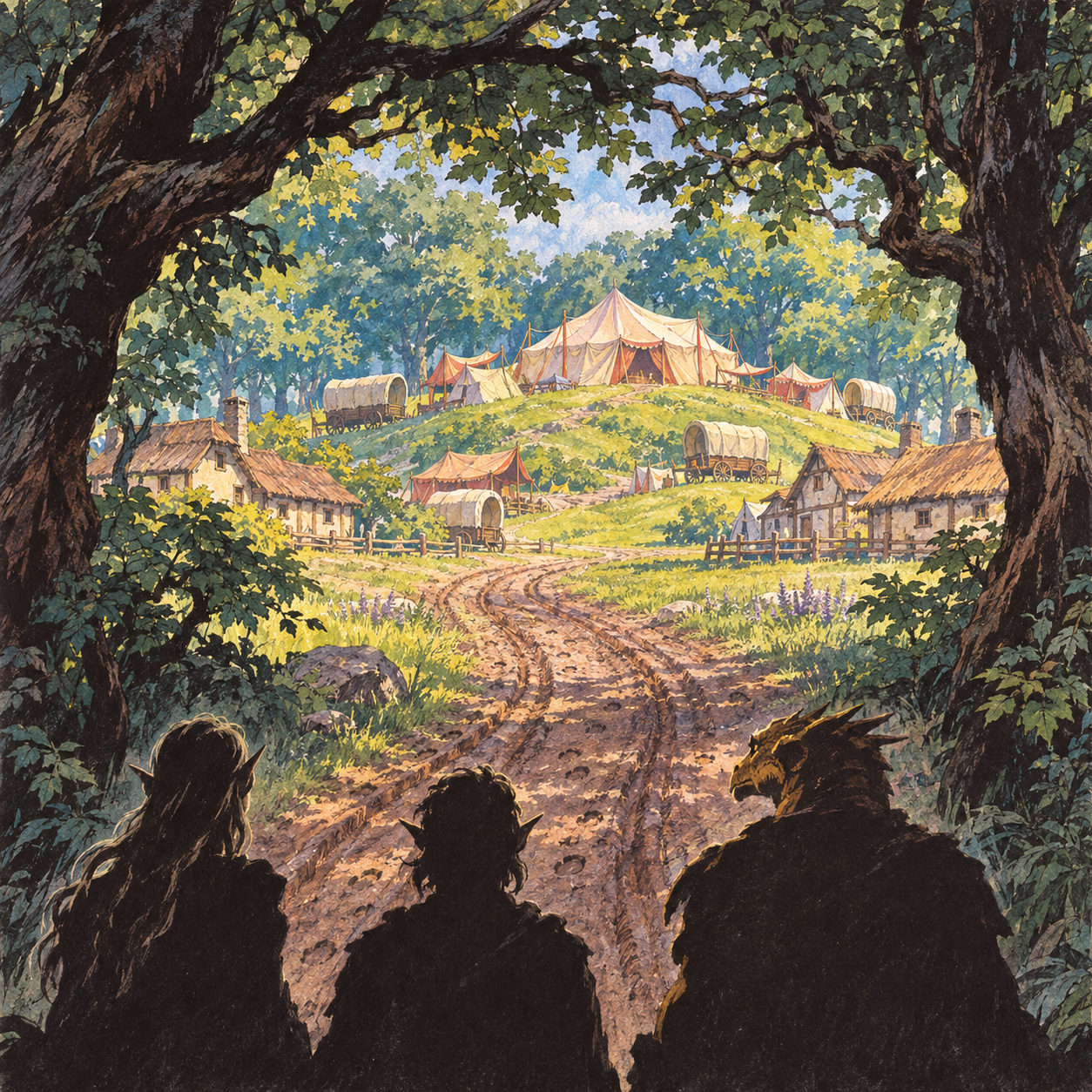
When they came out into the clearing, she stopped long enough to look up. The sunlight was brighter, and not merely because they had left the branches behind. Colours had gained weight: cloth on the wagons, clothing, the green around the clearing’s edge. After the long grey of Barovia, it was startling.
A low hill rose at the centre. Wagons and tents dotted its slopes and crown, with one large tent at the top. Around its base stood several permanent buildings. The track climbed among them, carrying the marks of the wagons that had gone ahead.
People tended horses, and cooking was underway. Conversations crossed one another while children ran at games whose rules were perfectly clear to them and unnecessary to everyone else. Elora watched one dart past, entirely occupied with reaching somewhere before another child did.
This was still Barovia, as far as she knew. Vallaki was meant to be protected too, its founding bound up with Vistani who had chosen to stay. Yet protection had not made its dining rooms sound like this. She could see the difference, but she could not explain it.
The people they approached were friendly, if careful with strangers. This was a larger camp than the one where they had met the fortune teller, and they had no reason to expect the same faces. When they asked for Kasimir, someone pointed toward a tent on the hill.
Thorn ducked beneath the flap and found a room.
Chairs, a bed, a table, trunks packed around the sides: the practical furnishings of a life carried from place to place. The woman seated within looked older than he had expected a human could be. He did not try to guess by how much.
When they showed her the crochet, recognition lit her face.
“Ah. You’ve spoken with Danika. I gave her that not long ago. She said she’d return it.”
There was something steadying in so small a piece of history arriving intact. Thorn took a chair and laid out their purpose: the crown, the journeys, their return to a land where events seemed to have resumed without regard for anything they had done.
Kasimir began with the Vistani. Her people had travelled for centuries, trading, making things to sell, entertaining, following their roads from place to place. In the stories, they had once passed through the aftermath of a great battle and found a man near death. They had taken him in and nursed him back to life.
The man was Strahd.
In gratitude he had promised them safe passage through Barovia for as long as the land was his. Whatever else had become of him, that oath still held. Travelling Vistani were protected, and so were those who chose to remain.
“How long ago?” Elora asked.
“Centuries. Two hundred, perhaps three.”
Thorn thought of the year Danika had given them. Kasimir believed the local reckoning began with Strahd’s rule, or with his becoming a vampire. She could not say which.
“Did your people have anything to do with that?” he asked. “With what he became?”
“No.”
She did not know exactly how or when he had been changed. The stories she knew agreed he had been ruthless long before. The battle in which they found him had been part of his campaign to conquer the land.
“They found someone who needed help,” Thorn said.
“Yes.”
The man they rescued had become the creature they knew, and still he had kept his promise. Thorn could find little comfort in that. An oath from Strahd could preserve the sunlight of this camp while leaving everyone else at his mercy. The Vistani could scarcely have known what would follow when they helped him.
Barovia, Kasimir told them, no longer lay along the Sword Coast as it once had. It had become another realm. Her people still reached it by secret roads, protected by the bond with Strahd.
“Roads between planes?” Elora asked.
“I don’t know much about such things. I know where the roads lead.”
Another realm could mean another ruler’s territory. Thorn raised the distinction, but Kasimir had a simpler observation: people who were not Vistani could take some of the same paths and never reach Barovia at all.
For her people, she said, this was among the safest places to travel. Elsewhere there were bandits and worse. Here their safety was promised, whatever happened to those who lived in the land.
Thorn let the question of roads rest. They had come for a story.
“The wizard,” he said.
Kasimir nodded.
“If you ask in town, they’ll tell you he came last year. I knew the tale when I was a child. The Vistani have told it for as long as I know.”
In that tale, a wizard had arrived wearing a dark and twisted crown. He promised freedom from Strahd. People believed him and followed him to the castle. Very few survived.
Thorn listened without interrupting. He could imagine the pull of that promise too readily, especially now that he had heard what an annual event it seemed to Danika.
“The people here say the wizard was never seen again,” Kasimir went on. “Our story tells more.”
The wizard and Strahd had fought upon the castle ramparts, hurling great magic at each other. At last the wizard fell from the castle and down the cliffs. The assumption had always been that Strahd prevailed.
Thorn could picture the height. He remembered enough of the castle to dislike the thought of falling from it. But Kasimir had said fell, and assumed. Neither word told him what had become of the crown.
“Since that day,” she said, “whenever my people come through Barovia, we find it as it was. We may see changes while we’re here. When we return, it is as it was before.”
Outside, someone murmured to a horse, and a child called to another child. Thorn sat with his hands still, thinking of their victory. He had been asking himself whether it happened as he remembered. Kasimir offered a different possibility: that it had happened, and had not been allowed to last.
“We’ve been here twice,” he said. “Things do seem the same.”
“What happened on your first visit?”
“We defeated Strahd,” Elora said.
“Most fail. Well done.”
“Apparently not.”
“Oh, I’m sure you may have destroyed him. Or the version of him here in his realm.” Kasimir regarded them calmly. “A few groups have succeeded. Most die. They’re buried outside the town of Barovia.”
Thorn thought of their own graves. For a moment the question rose in him as if for the first time: what if they went there and found their names? Then memory supplied the earth already opened, the bodies already seen. Their bodies, from Strixhaven. They had stood over that impossible evidence before ever hearing this.
Could they be among the people who kept coming back, successful on one passage, dead on another?
“It might be us,” he said. “Some of the groups coming through.”
Elora looked at him. He could see the idea take hold in her, and checked it before it set too hard.
“We don’t know.”
Kasimir had personally met other adventurers who looked nothing like them. Their presence did not account for everyone in the stories. Still, she allowed, they might have been here more often than they remembered.
“Or perhaps you’ll come again later.”
Thorn looked down at his hands. A perfectly ordinary sentence, until he considered what later might mean. They had saved themselves at Strixhaven. They had found themselves buried here. Somewhere among the repetitions a wizard had fallen wearing a crown, and that was the point from which the Vistani said the land kept returning.
He wanted to make a pattern of it, but too much was missing. They did not know what the wizard had intended, what the crown had done, or whether the fall had been an ending at all.
“Was his name Knogbrüth?” Elora asked.
Kasimir weighed it. The name that had come down through the stories sounded like “Nok Brute,” but she would not swear it was the same.
Thorn set it silently beside the name they knew. Time and retelling could account for the difference. So could something they had not considered.
Kasimir studied him and Elora.
“It’s been a long time since I’ve seen elves coming through,” she said. “There is someone you might wish to meet. He’s been here far longer than I have.”
She led them outside and pointed down the hill to one of the permanent houses. Those buildings belonged to his people. This was their home; they allowed the Vistani to camp here in passing.
“He may know more than our tales can tell you.”
Thorn followed the line of her hand to the house. Someone there might remember further back.
They went down through the camp, past the wagons and the children and the ordinary business of an evening meal. After the dim forest and the muted inn, the voices still sounded unreasonably clear.
At the house, they knocked. The door opened, and an elf stood on the other side.
“You’re finally here,” he said. “Please come in.”
Blue Water Inn — Elora and the rooftop ravens Still in raven form on the peak of the two-story inn, Elora continued speaking with the bird who had asked whether she was one of them. She answered that she was not and asked who he was. The raven abruptly resorted to ordinary bird noises, glancing around and watching her reaction. Elora’s Insight result of 19 made the performance unconvincing: he appeared to be pretending that he could not understand her. Elora briefly considered abandoning the exchange, then changed her mind. She told the raven that she knew he understood her and that the adventurers wanted to help. The other ravens exchanged looks and hopped away. The speaker resumed talking, explaining that a real raven had never landed among them before and that he did not know how to respond. Elora explained that she was an adventurer who had taken raven form so she could communicate with them. His assessment was: “You asked who my family was. I’m very confused. You’re a very weird raven.” Asked how the companions might help, the raven suggested killing Strahd. He said his family had spent a couple of hundred years trying to work out how to do that. Elora called information down to Thorn and Maledurk in the street, while Thorn shouted questions back up. Their conspicuous conversation drew stares from passersby. The speaker introduced himself as Bram Martikov. He denied being a wizard or a guardian of the city and described himself as a third grader, confirming that he was a child. According to Bram, his family were people who sometimes appeared as ravens and sometimes as people. He could not reliably identify all the other birds while they were in raven form, admitting that he sometimes forgot who was who. He thought his parents were working inside the inn. Elora flew down and reported what she had learned. She initially treated the rooftop group as children who could change shape, but Thorn distinguished Bram’s account from those assumptions: only Bram had identified himself as a child, and nothing yet established that any of the birds controlled their transformations. With a family name and a likely connection to the inn’s staff, the companions decided to investigate inside. Maledurk also wanted a tankard of ale. Blue Water Inn — Questions over ale The common room was busier than during the companions’ early-morning arrival, though hardly lively. Mostly human patrons ate in small groups, waitstaff circulated, and a woman tended the bar, but there was little conversation. Maledurk received his tankard and asked the bartender about the rooftop birds who thought they were people. She gave him a strange look, suggested that he might already have had too much to drink, and acknowledged that ravens were often around without explaining what he had encountered. Thorn called from the doorway to ask about her child. She eventually answered that he was presumably playing with friends. Thorn then made a conspicuous entrance, drawing a few glances before the patrons returned to their meals. Neither his question nor Maledurk’s direct approach persuaded the bartender to discuss the ravens openly. Thorn’s questions about Strahd had a much stronger effect. When he asked whether Strahd was around, how to find him, and what people thought of him, the remaining room noise stopped and the patrons stared. Thorn read apprehension and concern in their response, including possible suspicion that the strangers might be Strahd’s servants. No one acted against the companions, but the reaction made the room’s fear apparent. The bartender introduced herself as Danika Martikov and said that her family owned the inn. She assumed Strahd would be sleeping at his castle because it was daytime, while making clear that she did not actually know his schedule. The companions recalled their previous confrontation with Strahd and their knowledge of his castle and resting place, then reconsidered whether another confrontation would serve their present purpose. Their reason for returning to Barovia was to investigate the crown and their own altered history, following discoveries such as their earlier involvement in saving themselves at Strixhaven. Elora also recalled their broader concern about a great threat and the need for allies. She explained that bringing Ireena to Vallaki had been a deliberate departure from their first visit, intended to test whether they could change events. The crown itself remained with Veyr, with Tempest overseeing its study at the tower; the three travelers were seeking information about it. Turning to that investigation, the companions asked Danika about a magical crown associated with the lich Knogbrüth. She did not recognize his name and had not personally seen the wizard they were discussing. She had, however, heard a story about a wizard wearing a crown who came to Barovia and tried to defeat Strahd. Her version of the familiar crowned-wizard story presented a striking problem in its dating. Danika said people described the expedition as having happened a year ago, yet her grandmother had told her the same story when she was a child. Elora looked for a much older patron who might explain the discrepancy, but no one fitting that description was present. Danika then pointed out that her grandmother was still alive. She was traveling with the Vistani and was currently at the camp west of Vallaki. Danika later supplied her name: Kasimir. Lowering her voice, Danika described many townspeople as merely going through the motions of life: eating, working, returning home, and repeating the routine without apparent purpose. To her, it seemed almost as though something controlled them. She contrasted this with Vistani who traveled or chose to settle and appeared to be living their own lives. Her grandmother’s stories, she said, described the townspeople as having always behaved this way. The companions considered how those routines might relate to their own troubles. Asked about Vallaki’s festival preparations, Danika explained that there was a festival every week. The themes changed, but the celebrations followed much the same hollow pattern. This week’s preparations seemed to involve collecting sticks for a wicker sun; she expected an outdoor meal and a speech to follow. Danika also said that she had two children and that both they and she were Vistani; she had stopped traveling to run the inn. Danika gave the local year as 245, though its relation to the companions’ own calendar remained uncertain. She said she and her husband had built the inn about two years earlier because there had been no inn and they expected customers. Nevertheless, she now felt stuck. Her grandmother had told the old stories while they were still traveling through Barovia and elsewhere, yet those same stories seemed to keep happening. The companions described their earlier pursuit and defeat of Strahd, their escape through the mist, and their arrival elsewhere. Danika knew stories of other people killing him, but said he still prowled the night and that only Vistani were safe outside the walls. She attributed Vistani freedom of travel to an ancient pact with him. The companions considered several explanations for their experience: a reset, a visit to another point in history, or a previous victory that had somehow failed to last. Maledurk proposed finding the beginning of the timeline. Thorn favored consulting the western Vistani before attempting another journey to Strahd’s castle. The castle was distant, and their earlier travels had included nighttime attacks. Elora agreed that killing Strahd again would not necessarily bring them closer to answers about the crown. Danika said the camp was only a couple of hours away on foot. With it being about midday, the companions chose to seek older witnesses there before deciding whether another confrontation was useful. In considering travel, the companions distinguished two resources already available to them. Veyr’s return wand would take them back to his tower; a separate wand of teleportation could take them to destinations they had visited and knew. The village of Barovia and, theoretically, Strahd’s castle were possible destinations for the latter. It had not originally offered a way to reach unvisited Vallaki. Neither wand was activated, and the companions retained both options while choosing to walk to the camp. Before they left, Danika gave the party a small decorative crocheted piece, roughly the size of a washcloth. She had intended to return it to Kasimir and said that her grandmother would recognize it as evidence that Danika had sent them. Asked about magical powers, Danika knew of none. Elora thanked her and agreed that they would take it along as their introduction. Blue Water Inn — The Martikov secret As departure approached, Elora brought up the rooftop children again. This time, Maledurk noticed Danika looking around uneasily and withholding information. All three companions had tried to read her reaction, but only Maledurk caught the significant evasion. Elora pressed the connection between the birds and Danika’s children. Rather than continue in front of the customers, Danika took all three companions into a back kitchen area for a private conversation. Danika explained that Strahd had cursed her husband’s family, identifying them as wereravens. She and her husband had hoped that her being from outside Barovia would keep the curse from passing to their children, but that hope had failed. According to her, the children had inherited it as well. Her account explained Bram’s description of a family who were sometimes people and sometimes ravens. Her husband, Danika said, was human and could ordinarily choose between his human and raven forms. The exception was the full moon, when he lost control over the change. Their children could become people again, but did not yet control when their transformations happened. Based on her husband’s family’s experience, she thought that control might improve as they grew older. Danika rejected the suggestion that her husband hunted victims like a werewolf. She said the Martikov family was dedicated to destroying Strahd in the hope that his destruction would end the curse. More immediately, she explained that the family could not leave Barovia: that was the real reason they had remained there. Asked about her maiden name, she said she had none and that Vistani typically did not use surnames. Elora offered another possible route to helping them. If the companions could solve the crown mystery and deal with whoever lay behind it, perhaps they could break the family’s curse as well. Their previous defeat of Strahd had apparently failed to end Barovia’s problems, which strengthened her determination to investigate further. She also hoped to help the townspeople who seemed trapped in purposeless routines. Danika welcomed the possibility, but knew nothing specific showing that the crown could provide such a remedy. Danika said outsiders stood out because they had their own goals and seemed able to pursue them. Groups arrived every year promising to destroy Strahd, yet he remained. She wished the companions success and emphasized that her grandmother remembered more history than she did. Her own experience of repetition remained troubling: “I feel like I’ve been through things many times before.” With Danika’s confidence, directions, and crocheted introduction, the companions left for the western camp. West of Vallaki — The forest trail and the brighter clearing Elora, Thorn, and Maledurk traveled on foot for a couple of hours, first along the road and then onto a clearly used wagon trail through denser forest. Wagon grooves and horse prints marked the route. Trees crowded close to the trail, making it darker than the road and an unappealing place to be after nightfall. The route was not hidden, and they reached their destination without an attack, injury, or expenditure of their magical travel resources. The forest opened into a clearing containing a low hill, roughly fifteen to twenty feet high. Wagons and tents stood on the hill, including a large tent at the top, while several permanent buildings surrounded its base. This was a different, larger camp with a more permanent arrangement than the riverside camp where the companions had previously met the fortune teller. The clearing presented a marked contrast with Vallaki and the surrounding Barovian countryside. The sunlight appeared stronger and the colors more vibrant. Adults talked, tended horses, and prepared food, while children ran and played. The inhabitants’ activity reinforced the difference between this community and the subdued townspeople Danika had described. The companions revisited the distinction between traveling Vistani and those who had settled in Vallaki, along with the protection attributed to the town’s Vistani founders. The apparent lack of agency among some townspeople still required explanation; it did not seem to describe everyone, with the Martikovs and burgomaster standing out as exceptions. Residents of the camp were friendly but somewhat wary of the strangers. When asked for Kasimir, they directed the companions to her tent on the hill. Kasimir’s tent — The pact, the wizard, and Barovia’s recurring story Kasimir was a very old woman, appearing older than the companions would ordinarily expect a human to be. Her spacious tent held chairs, a bed, numerous trunks, and a table. The companions presented Danika’s crocheted piece, and Kasimir recognized it immediately. She asked whether they had spoken with Danika and explained that she had given her the piece not long ago with the understanding that it would be returned. The introduction worked, and Thorn outlined the party’s situation and asked about the crown and the larger mystery. Kasimir began with the history of the Vistani, describing centuries of travel, trade, craft, and entertainment. According to their ancestral stories, Vistani had once found a man near death after a battle in Barovia and nursed him back to health. That man was Strahd. In gratitude, he promised them safe passage through his lands for as long as he ruled them. Kasimir said that this was the origin of the protection Danika had mentioned. In Kasimir’s account, Strahd continued to honor that promise after becoming a vampire. It protected Vistani who passed through his lands as well as those who chose to settle there, while other inhabitants remained at his mercy. She could place the rescue only broadly, perhaps two or three centuries earlier. She also thought the local calendar began either with Strahd’s accession or his transformation, but could not say which. Asked whether the Vistani had turned Strahd into a vampire, Kasimir said no. She knew no concrete account of how or precisely when that change had happened, and no one she had spoken with had supplied one. She described him as ruthless and already pursuing conquest when her ancestors saved him. Kasimir said Barovia no longer occupied its former place along the Sword Coast and had become another realm. The Vistani could still reach it by secret roads because of their bond with Strahd and his oath. She considered those routes ironically safer than some other journeys because of his promised protection. When Thorn questioned what she meant by a separate realm, she added that non-Vistani taking some of the same paths did not arrive in Barovia. Turning to the crown, Kasimir recounted an old Vistani tale she had known since childhood. As with Danika’s account, townspeople nevertheless placed the event in the previous year. A wizard wearing a crown had promised freedom from Strahd, gathered local supporters, and led an attack on the castle. Few of those recruits survived. Kasimir described the wizard’s crown as dark and twisted; whether it was the same crown now being studied by Veyr remained an open question. Local accounts, she said, held that the wizard was never seen again. The Vistani version described a tremendous magical duel between the wizard and Strahd on the castle ramparts, ending with the wizard falling down the cliffs. Tradition assumed that Strahd had won. That interpretation differed from Madam Eva’s earlier belief that the wizard had prevailed despite the reported fall. Neither account settled who actually won, whether the wizard survived, or what became of his crown. Kasimir then supplied a more specific connection to Barovia’s apparent repetition. According to her, ever since the day of the duel, returning Vistani had found the land restored to the state in which they had previously encountered it, despite changes they had seen during their visits. She associated the recurrence with the confrontation’s aftermath, though how it worked remained unknown. The companions told Kasimir that they had defeated Strahd during their earlier visit. She congratulated them and said she believed they had destroyed him, or the version of him present in this realm. According to her, a few other adventuring groups had also succeeded. Most failed, died, and were buried outside the village of Barovia. Thorn wondered whether the companions’ own names might appear in that graveyard. They recalled that they had already found graves bearing their names, opened them, and discovered the bodies of their former Strixhaven identities. In light of Kasimir’s story, those bodies remained relevant to the question of how often the companions might have passed through Barovia and what they remembered of those visits. The companions considered whether they might themselves be the adventurers who kept arriving. Kasimir replied that she had personally met other groups who did not look like them. She allowed that the companions might have made visits they did not remember, or might return again in their own future. Looking at Elora and Thorn, Kasimir remarked that it had been a long time since she had seen elves coming through. She offered a further source: someone who had lived there much longer than she had and might know more. Outside her tent, she pointed out a permanent house below the hill. She explained that the people living in those buildings were the site’s resident community and allowed traveling Vistani to camp on their land. The party now had a specific local contact to approach beyond the traditions Kasimir could recount. Before leaving, Elora asked whether the expedition wizard had been named Knogbrüth. Kasimir said the name preserved in her stories sounded like “Nok Brute,” but she did not know whether it was the same name. The companions considered whether it might indicate the same person, a relative, or a pronunciation altered through languages and generations. The resemblance strengthened the lead connecting Knogbrüth to the expedition, while leaving both the wizard’s identity and his reported crown’s connection to their own unresolved. The house below the camp — An expected arrival Following Kasimir’s directions, the three companions approached the indicated permanent house and knocked. An elf opened the door and greeted them: “You’re finally here. Please come in.” His words suggested that he had been expecting their arrival, but supplied no explanation of why. The session ended at that invitation, before the companions entered or began a conversation inside. The elf’s name, what he knew, and whether he recognized these particular visitors remained unanswered. They had reached the longer-standing resident Kasimir recommended, with the crowned wizard’s identity, the fate of his expedition, and the reason Barovia’s changes apparently failed to persist still at the heart of their investigation.Session Notes